Energy Ingredients Market Size, Share & Trends Analysis Report By Product (Caffeine, Creatine, Taurine, Ginseng) And Application (Food, Beverage, Supplements And Others), By Region, And Segment Forecasts, 2024-2031

Report Id: 1562 Pages: 180 Last Updated: 17 April 2024 Format: PDF / PPT / Excel / Power BI
Share With : linkedin twitter facebook

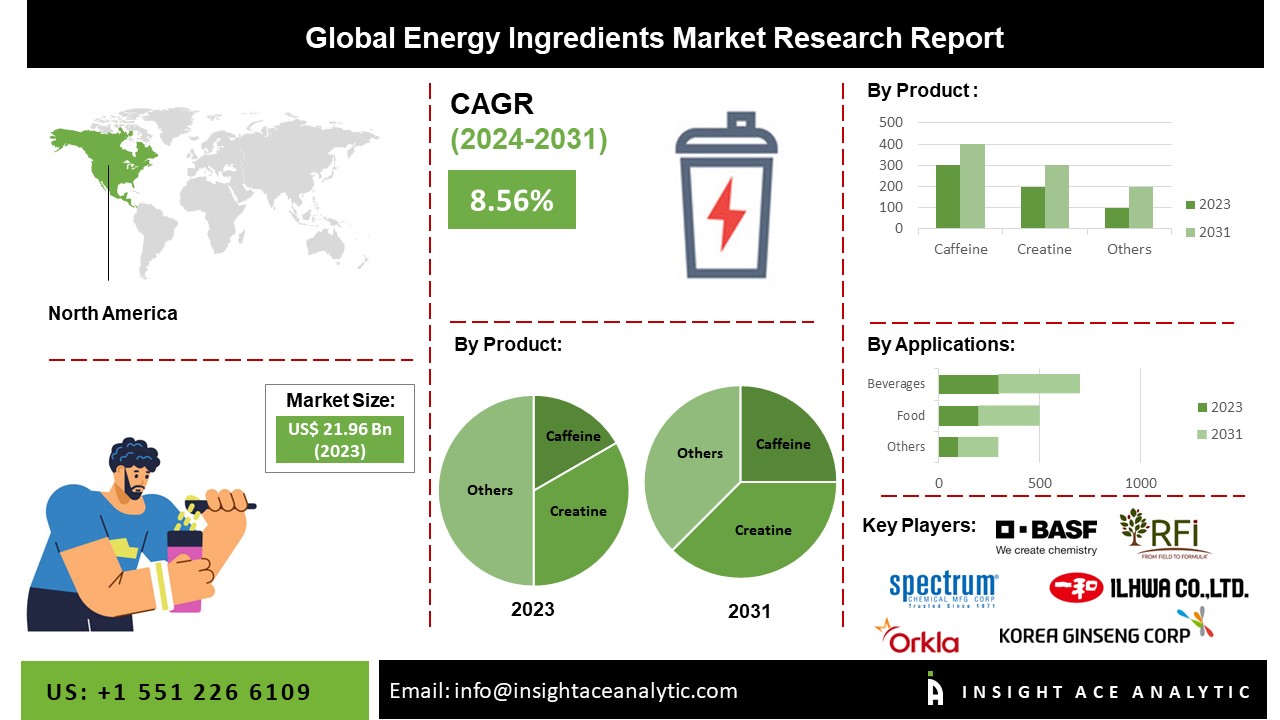
The Global Energy Ingredients Market Size is valued at USD 21.96 billion in 2023 and is predicted to reach 41.91 billion by the year 2031 at an 8.56% CAGR during the forecast period for 2024-2031.

Key Industry Insights & Findings from the Report:

  • The energy ingredients market has grown as a result of the increasing accessibility of energy products due to globalization, which is leading to market growth.
  • The growing modern technology has led to an aging population, increased urbanization, and altered lifestyles in the expansion of this market.
  • North America dominated the market and accounted for a global revenue share in 2023.
  • One of the significant concerns is restraining the high production costs, numerous tests, and stringent guidelines and safety requirements.

 energy ingredients

Beverages are non-alcoholic drinks with caffeine and other nutrients such as B vitamins, taurine, guarana, and ginseng. Some of these components, like guarana, naturally contain caffeine, while others, like ginseng, contribute to the distinctive flavour found in energy drinks. The demand for smoothies and other stimulating beverages in the global energy ingredient market is being driven by economic growth.

Energy ingredient demand from consumers is anticipated to rise, fueling market expansion. A fast-paced lifestyle, improved customer health, and nutrition will contribute to the sector's rapid growth. Especially among health-conscious consumers, marketing that positions energy ingredients as a healthier alternative to carbonated drinks has resulted in a boom in the industry.

Additionally, the market for energy ingredients is benefiting from consumer demand because these drinks contain some ingredients that have positive health effects. These drinks contain a lot of vitamin B, which helps to prevent many chronic diseases. Because they contain a lot of niacin, this energy ingredient can help people with low red blood cell lipids and arthritic symptoms. However, rising raw material costs, escalating raw material prices, fluctuating currency exchange rates, and rising electricity costs have all resulted in higher prices for various product groups, posing new difficulties for industry participants.

The market is also expected to expand soon due to a change in consumer lifestyle and a rise in awareness of health and wellness products. The growing consumer interest in energy ingredients like taurine due to its many health benefits will drive the segment's growth. Energy drinks contain the substance to calm the nervous system and boost the mind. Leading industry producers are releasing unique products with taurine as their primary ingredient to raise product visibility among consumers. 

Key Developments:

  • In Dec 2022, The Korea Ginseng Corporation has created a new line of Koreselect products . Accessible exclusively online, the new goods serve as special function supplements and include ashwagandha, elderberry, beet root, milk thistle, American ginseng, and women's probiotics.These new products are the first of many planned additions to the existing Korean red ginseng-based Koreselect brand family which has been specifically designed for the health-conscious American consumer and contains all natural herbal ingredients.
  • In Dec 2022, Orkla Foods Europe has entered into an agreement to purchase 100 per cent of the shares in Khell-Food Kft., the largest producer of ready-made sandwiches and baguettes in the Hungarian market.The purchase of Khell-Food will be carried out by Orkla Foods ?esko a Slovensko (CaS), which is part of Orkla Foods Europe. CaS is already established in the Hungarian market through its subsidiary Hamé Hungary. 

Competitive Landscape:

Some major key players in the Energy Ingredients market are Corp

  • RFI Ingredients
  • Korea Ginseng Corporation
  • Orkla
  • ILHWA CO., LTD.
  • Applied Food Sciences, Inc. (AFS)
  • Naturalin Bio-Resources Co., Ltd.
  • Changsha Huir Biological-Tech Co., Ltd.
  • Sinochem Pharmaceutical Co., Lt
  • KOEI KOGYO CO., LTD
  • Aarti Industries Ltd.
  • Other Prominent Players

Market Segmentation:

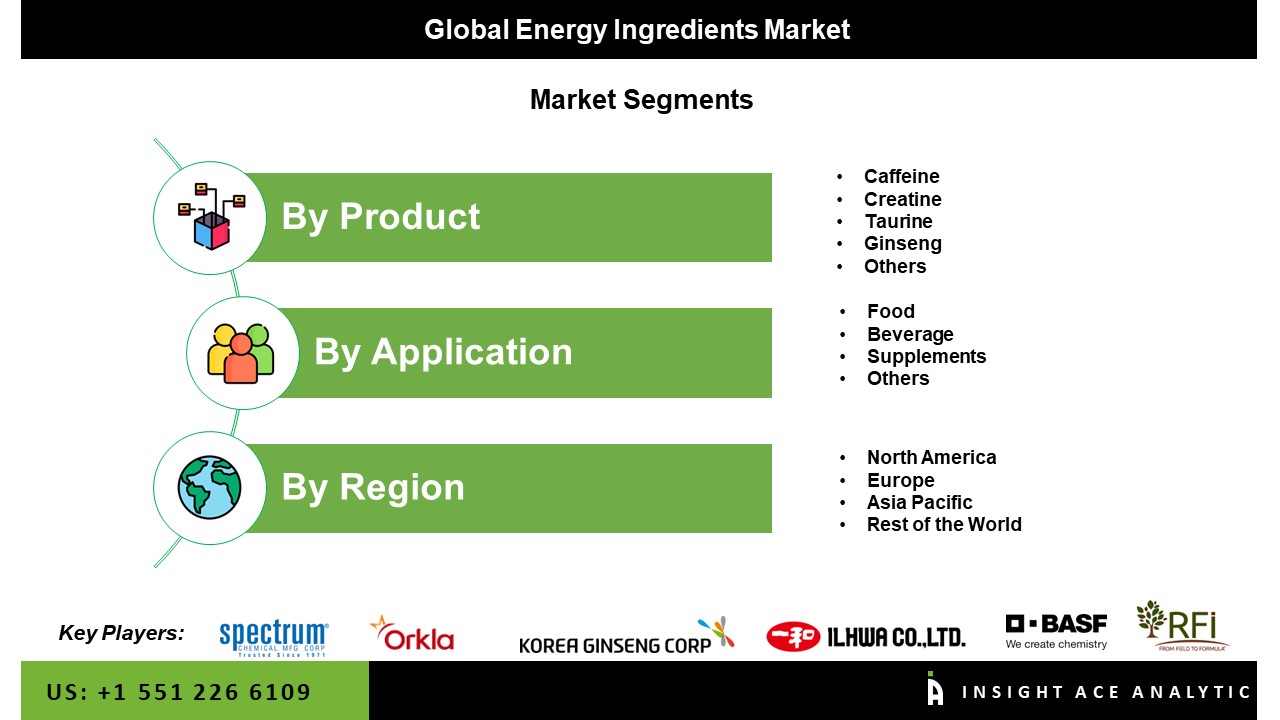
The energy ingredients market is segmented on the product and application. Based on product, the energy ingredients market is segmented into caffeine, creatine, taurine, ginseng and others. Based on application, the energy ingredients market is segmented into food, beverage, supplements and others.

Based On Product, The Caffeine Segment Is A Major Contributor To The Energy Ingredients Market

The market's leading segment was caffeine. Caffeine's expansion as an energy element can be linked to its ability to increase energy by reducing calorie intake. Additionally, caffeine activates the sympathetic nervous system, which aids in decreasing appetite, promoting fullness, and accelerating fat cells' breakdown for energy use. These effects are anticipated to complement the market's expansion during the forecast period.

The Beverages Segment Witnessed Growth At A Rapid Rate

Beverages grabbed the highest revenue share, and it is anticipated that they will continue to hold that position during the anticipated time. The increased popularity of energy drinks| will assist in broadening the segment's appeal because they provide quick bursts of energy while also stimulating the mind and body. As a result, major producers are introducing beverages with caffeine as their primary component to enhance consumer health.

The North American Energy Ingredients Market Holds A Significant Regional Revenue Share

The North American energy ingredients market is expected to register the highest market share in revenue soon his region's energy ingredients market is expanding quickly due to rising urbanization and a robust economy. These ingredients are also promoted as healthier alternatives to carbonated drinks, especially for health-conscious people. In addition, Asia Pacific is projected to grow rapidly in the global energy ingredients market. Youth in this region is consuming more energy ingredients, which is positively influencing the growth of the global Energy Ingredient market. Energy ingridients sales in this region are growing thanks to rising disposable incomes and living standards in China and India. The expansion of the global energy ingredients market is fueled by the increasing popularity of sports and premium brands over the projected period.

Global Energy Ingredients Market Report Scope:

Report Attribute Specifications
Market size value in 2023 USD 21.96 Bn
Revenue forecast in 2031 USD 41.91 Bn
Growth rate CAGR CAGR of 8.56% from 2024 to 2031
Quantitative units Representation of revenue in US$ Million, Volume in Tons and CAGR from 2024 to 2031
Historic Year 2019 to 2023
Forecast Year 2024-2031
Report coverage The forecast of revenue, the position of the company, the competitive market structure, growth prospects, and trends
Segments covered Product Type, Application
Regional scope North America; Europe; Asia Pacific; Latin America; Middle East & Africa
Country scope U.S.; Canada; U.K.; Germany; China; India; Japan; Brazil; Mexico; The UK; France; Italy; Spain; China; Japan; India; South Korea; Southeast Asia; South Korea; Southeast Asia
Competitive Landscape BASF SE; Spectrum Chemical Mfg. Corp.; RFI Ingredients; Korea Ginseng Corporation; Orkla; ILHWA CO., LTD.; Applied Food Sciences, Inc. (AFS); Naturalin Bio-Resources Co., Ltd.; Changsha Huir Biological-Tech Co., Ltd.; Sinochem Pharmaceutical Co., Ltd.; KOEI KOGYO CO., LTD; Aarti Industries Ltd.
Customization scope Free customization report with the procurement of the report, Modifications to the regional and segment scope. Particular Geographic competitive landscape.
Pricing and available payment methods Explore pricing alternatives that are customized to your particular study requirements.

Segmentation of Energy Ingredients Market-

Energy Ingredients Market By Product

  • Caffeine
  • Creatine
  • Taurine
  • Ginseng
  • Others

energy ingredients

Energy Ingredients Market By Application

  • Food
  • Beverage
  • Supplements
  • Others

Energy Ingredients Market By Region-

North America-

  • The US
  • Canada
  • Mexico

Europe-

  • Germany
  • The UK
  • France
  • Italy
  • Spain
  • Rest of Europe

Asia-Pacific-

  • China
  • Japan
  • India
  • South Korea
  • South East Asia
  • Rest of Asia Pacific

Latin America-

  • Brazil
  • Argentina
  • Rest of Latin America

 Middle East & Africa-

  • GCC Countries
  • South Africa
  • Rest of Middle East and Africa

Need specific information/chapter from the report of the custom data table, graph or complete report? Tell us more.

Research Design and Approach

This study employed a multi-step, mixed-method research approach that integrates:

  • Secondary research
  • Primary research
  • Data triangulation
  • Hybrid top-down and bottom-up modelling
  • Forecasting and scenario analysis

This approach ensures a balanced and validated understanding of both macro- and micro-level market factors influencing the market.

Secondary Research

Secondary research for this study involved the collection, review, and analysis of publicly available and paid data sources to build the initial fact base, understand historical market behaviour, identify data gaps, and refine the hypotheses for primary research.

Sources Consulted

Secondary data for the market study was gathered from multiple credible sources, including:

  • Government databases, regulatory bodies, and public institutions
  • International organizations (WHO, OECD, IMF, World Bank, etc.)
  • Commercial and paid databases
  • Industry associations, trade publications, and technical journals
  • Company annual reports, investor presentations, press releases, and SEC filings
  • Academic research papers, patents, and scientific literature
  • Previous market research publications and syndicated reports

These sources were used to compile historical data, market volumes/prices, industry trends, technological developments, and competitive insights.

Secondary Research

Primary Research

Primary research was conducted to validate secondary data, understand real-time market dynamics, capture price points and adoption trends, and verify the assumptions used in the market modelling.

Stakeholders Interviewed

Primary interviews for this study involved:

  • Manufacturers and suppliers in the market value chain
  • Distributors, channel partners, and integrators
  • End-users / customers (e.g., hospitals, labs, enterprises, consumers, etc., depending on the market)
  • Industry experts, technology specialists, consultants, and regulatory professionals
  • Senior executives (CEOs, CTOs, VPs, Directors) and product managers

Interview Process

Interviews were conducted via:

  • Structured and semi-structured questionnaires
  • Telephonic and video interactions
  • Email correspondences
  • Expert consultation sessions

Primary insights were incorporated into demand modelling, pricing analysis, technology evaluation, and market share estimation.

Data Processing, Normalization, and Validation

All collected data were processed and normalized to ensure consistency and comparability across regions and time frames.

The data validation process included:

  • Standardization of units (currency conversions, volume units, inflation adjustments)
  • Cross-verification of data points across multiple secondary sources
  • Normalization of inconsistent datasets
  • Identification and resolution of data gaps
  • Outlier detection and removal through algorithmic and manual checks
  • Plausibility and coherence checks across segments and geographies

This ensured that the dataset used for modelling was clean, robust, and reliable.

Market Size Estimation and Data Triangulation

Bottom-Up Approach

The bottom-up approach involved aggregating segment-level data, such as:

  • Company revenues
  • Product-level sales
  • Installed base/usage volumes
  • Adoption and penetration rates
  • Pricing analysis

This method was primarily used when detailed micro-level market data were available.

Bottom Up Approach

Top-Down Approach

The top-down approach used macro-level indicators:

  • Parent market benchmarks
  • Global/regional industry trends
  • Economic indicators (GDP, demographics, spending patterns)
  • Penetration and usage ratios

This approach was used for segments where granular data were limited or inconsistent.

Hybrid Triangulation Approach

To ensure accuracy, a triangulated hybrid model was used. This included:

  • Reconciling top-down and bottom-up estimates
  • Cross-checking revenues, volumes, and pricing assumptions
  • Incorporating expert insights to validate segment splits and adoption rates

This multi-angle validation yielded the final market size.

Forecasting Framework and Scenario Modelling

Market forecasts were developed using a combination of time-series modelling, adoption curve analysis, and driver-based forecasting tools.

Forecasting Methods

  • Time-series modelling
  • S-curve and diffusion models (for emerging technologies)
  • Driver-based forecasting (GDP, disposable income, adoption rates, regulatory changes)
  • Price elasticity models
  • Market maturity and lifecycle-based projections

Scenario Analysis

Given inherent uncertainties, three scenarios were constructed:

  • Base-Case Scenario: Expected trajectory under current conditions
  • Optimistic Scenario: High adoption, favourable regulation, strong economic tailwinds
  • Conservative Scenario: Slow adoption, regulatory delays, economic constraints

Sensitivity testing was conducted on key variables, including pricing, demand elasticity, and regional adoption.


Name field cannot be blank!
Email field cannot be blank!(Use email format)
Designation field cannot be blank!
Company field cannot be blank!
Contact No field cannot be blank!
Message field cannot be blank!
4628
Security Code field cannot be blank!

Frequently Asked Questions

The Global Energy Ingredients Market Size is valued at USD 21.96 billion in 2023 and is predicted to reach 41.91 billion by the year 2031

Energy Ingredients Market expected to grow at 8.56% CAGR during the forecast period for 2024-2031

BASF SE; Spectrum Chemical Mfg. Corp.; RFI Ingredients; Korea Ginseng Corporation; Orkla; ILHWA CO., LTD.; Applied Food Sciences, Inc. (AFS); Naturali
Get Sample Report Enquiry Before Buying