Dietary Supplement Cultures Market Size, Share & Trends Analysis Report by Micro-Organism Type (Bacteria, Yeast And Mould), Application (Dairy Industry (Cheese, Yoghurt, And Other Fermented Milk Products), The Meat Industry And Beverages), And Functionality (Preservative Agents, Texturing Agents, - Market Outlook And Industry Analysis 2031
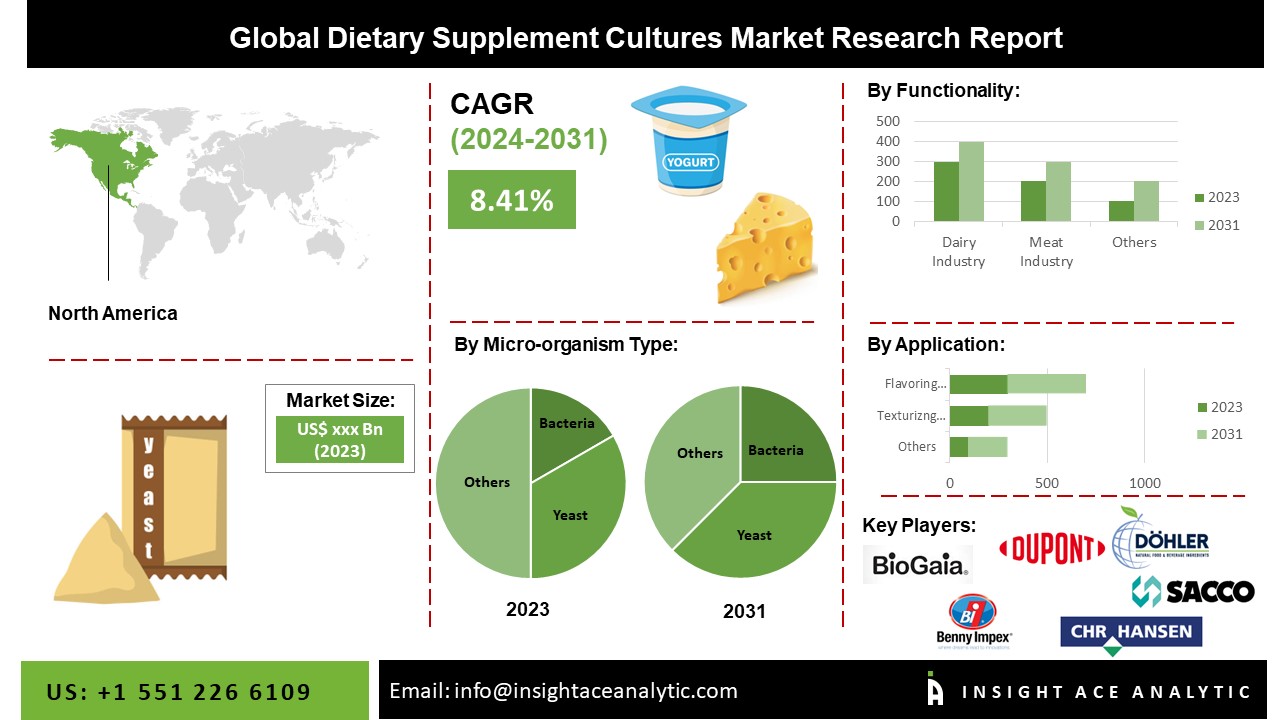
The Global Dietary Supplements Cultures Market Size is predicted to register at an 8.41% CAGR during the forecast period for 2024-2031.
Key Industry Insights & Findings from the Report:
- The aging global population creates opportunities for dietary supplement cultures targeting age-related health concerns.
- Increasing awareness about the importance of health and wellness is a significant driver.
- North America dominated the market and accounted for a revenue share of global revenue in 2023.
- The dietary supplement industry is subject to complex and evolving regulations.
Dietary Supplements have quickly been included in consumers’ diets to fulfil human nutritional inadequacies. Hence, the adoption of dietary Supplements is expected to increase in the near future as concerns grow over the health care benefits. Growing adoption of different kinds of diet Supplements, like minerals, vitamins, and immunity-boosting products, to complete a healthy diet requirement are factors expected to drive the growth of the dietary Supplements cultures market. Growing consumer health awareness and an increasing number of dietary Supplements applications in various industries are some of the other factors expected to augment the target market growth in the next coming years.
However, the high cost of dietary Supplements and availability of synthetic products, coupled with the COVID-19 outbreak, are factors that may limit the growth of the target market during the forecast period. Furthermore, increasing R&D activities, government initiatives to use sustainable components for production, and prominent players' investments are expected to create lucrative growth opportunities in terms of revenue for players operating in the dietary Supplements cultures market over the forecast period.
Competitive Landscape:
Some of the major key players in the dietary Supplements cultures market are:
- BioGaia AB
- DuPont
- Nutraceutical Inc.
- Hansen Holding A/S
- Dohler
- Vitakem DSMZ
- Frutarom Health
- Genesis Laboratories
- Sacco SRL
- Mediterranea Biotechnologies SRL
- Biochem SRL
- Dalton Biotechnologies SRL
- THT S.A.
- Codex-ing Biotech Ingredients
- Bioprox
- Benny Impex
- ABsource Biologics
- Alliance India
Market Segmentation:
The Dietary Supplements cultures market is segmented on the basis of micro-organism type, application, and functionality. Based on micro-organism type, the market is segmented as bacteria, yeast and mould. By application, the market is segmented into Dairy Industry (cheese, yoghurt, and other fermented milk products), the meat industry and beverages. By functionality, the market is segmented into preservative agents, texturing agents, others (coloring agents and nutritional agents) and flavoring agents.
Based On Micro-Organism Type, The Bacteria And Yeast Segment Is Accounted As A Major Contributor In The Dietary Supplements Cultures Market
The yeast and bacteria category is expected to hold a major share of the dietary Supplements cultures market in 2021. This is attributed to the growing usage of bacteria and yeast as it is cheap and environmental-friendly. Thus, there is a rise in the use of fermented products by consumers. Additionally, increasing demand for fermented food expanded dramatically due to their extended shelf life and favorable properties of lifespan.
Dairy Industry Segment Witnessed Growth At A Rapid Rate
The Dairy industry segment is projected to grow at a rapid rate in the dietary supplement cultures market owing to growing concerns towards health care benefits. Hence, with the growing popularity of dietary Supplements there is an increase in demand for dairy products in the dairy industry, especially in countries such as the US, Germany, the UK, China, and India.
In The Region, The North America Dietary Supplement Cultures Market Holds Significant Revenue Share.
The North America dietary Supplements cultures market is expected to register the highest market share in terms of revenue in the near future. This can be attributed to the substantial focus on the consumer’s health in the region, with the increasing adoption of dietary Supplements in different industries, including dairy industries, meat industries and beverage industries. In addition, the diet supplement industry in the region is focusing on the production of dietary products to develop sustainable and environmental-friendly solutions. In addition, Asia Pacific is projected to grow at a rapid rate in the dietary Supplements cultures market due to growing concerns about the environment, rapid industrialization, government initiatives, and increasing funding in various industries.
Recent Developments:
-
In Sept 2020, DuPont Nutrition & Biosciences (DuPont) has introduced a new range of dairy cultures and probiotic formulations specifically designed for the Chinese market. These innovative solutions provide yogurt manufacturers with opportunities for product differentiation and set them up for future expansion. Reports indicate that the introduction of new cultures has resulted in accelerated fermentation and increased levels of probiotics. Furthermore, these advancements have been achieved without compromising the mild flavor and high-quality texture that consumers expect.
-
In April 2023, BioGaia AB (publ) has introduced a probiotic dietary supplement that is specifically formulated for women who are pregnant or intending to become pregnant. Prenatal Care was a probiotic dietary supplement designed for expectant mothers and women who were considering pregnancy. It included folic acid, iron, and vitamin D3, in addition to BioGaia's patented bacterium strain L. reuteri DSM 17938.
Dietary Supplements Cultures Market Report Scope:
| Report Attribute | Specifications |
| Growth rate CAGR | CAGR of 8.41% from 2024 to 2031 |
| Quantitative units | Representation of revenue in US$ Million, and CAGR from 2024 to 2031 |
| Historic Year | 2019 to 2023 |
| Forecast Year | 2024-2031 |
| Report coverage | The forecast of revenue, the position of the company, the competitive market structure, growth prospects, and trends |
| Segments covered | Micro-Organism Type, Application, And Functionality |
| Regional scope | North America; Europe; Asia Pacific; Latin America; Middle East & Africa |
| Country scope | U.S.; Canada; U.K.; Germany; China; India; Japan; Brazil; Mexico; The UK; France; Italy; Spain; China; Japan; India; South Korea; Southeast Asia; South Korea; Southeast Asia |
| Competitive Landscape | BioGaia AB, DuPont, Chr. Nutraceutical Inc., Hansen Holding A/S, Dohler, Vitakem DSMZ, Frutarom Health, Genesis Laboratories, Sacco SRL, Mediterranea Biotechnologies SRL, Biochem SRL, Dalton Biotechnologies SRL,THT S.A., Codex-ing Biotech Ingredients, Bioprox, Benny Impex, ABsource Biologics, and Alliance India. |
| Customization scope | Free customization report with the procurement of the report, Modifications to the regional and segment scope. Particular Geographic competitive landscape. |
| Pricing and available payment methods | Explore pricing alternatives that are customized to your particular study requirements. |
Segmentation of Dietary Supplement Cultures Market-
Dietary Supplement Cultures Market By Micro-organism Type-
- Bacteria
- Yeast
- Mould
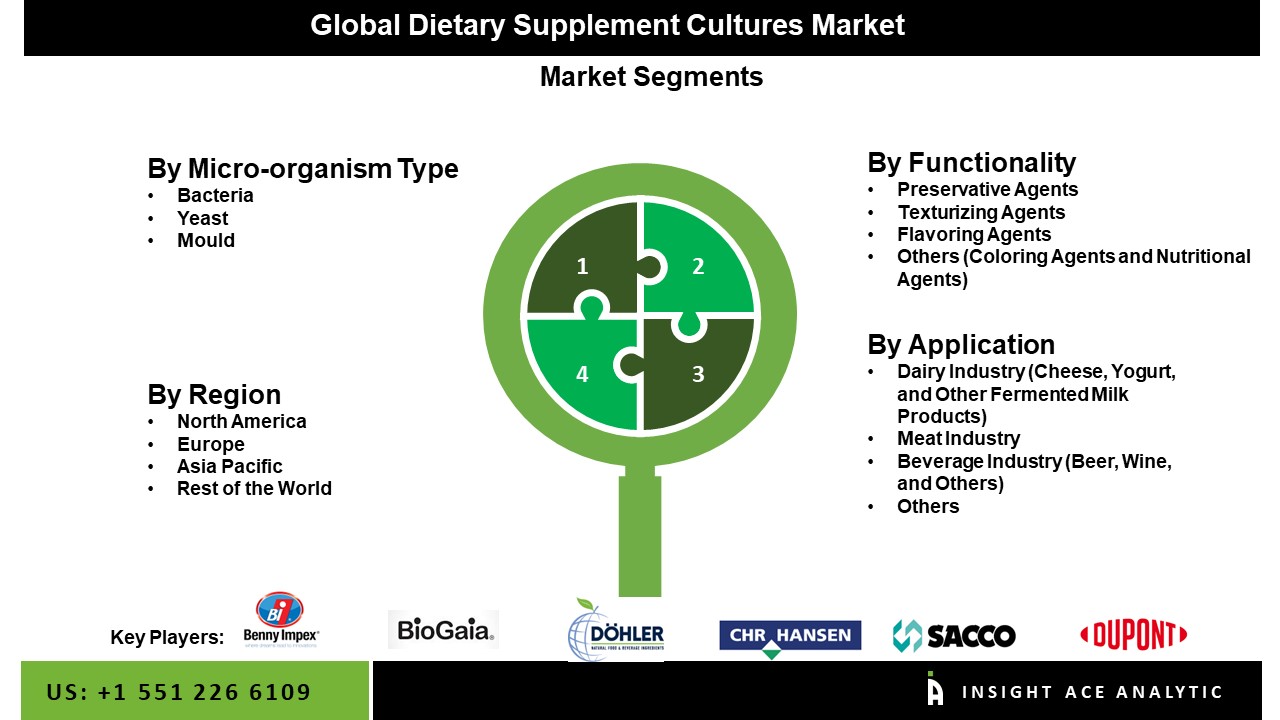
Dietary Supplement Cultures Market By Application-
- Dairy Industry (Cheese, Yogurt, and Other Fermented Milk Products)
- Meat Industry
- Beverage Industry (Beer, Wine, and Others)
Dietary Supplement Cultures Market By Functionality-
- Preservative Agents
- Texturing Agents
- Others (Coloring Agents and Nutritional Agents)
- Flavoring Agents
By Region-
North America-
- The US
- Canada
- Mexico
Europe-
- Germany
- The UK
- France
- Italy
- Spain
- Rest of Europe
Asia-Pacific-
- China
- Japan
- India
- South Korea
- Southeast Asia
- Rest of Asia Pacific
Latin America-
- Brazil
- Argentina
- Rest of Latin America
Middle East & Africa-
- GCC Countries
- South Africa
- Rest of Middle East and Africa
Research Design and Approach
This study employed a multi-step, mixed-method research approach that integrates:
- Secondary research
- Primary research
- Data triangulation
- Hybrid top-down and bottom-up modelling
- Forecasting and scenario analysis
This approach ensures a balanced and validated understanding of both macro- and micro-level market factors influencing the market.
Secondary Research
Secondary research for this study involved the collection, review, and analysis of publicly available and paid data sources to build the initial fact base, understand historical market behaviour, identify data gaps, and refine the hypotheses for primary research.
Sources Consulted
Secondary data for the market study was gathered from multiple credible sources, including:
- Government databases, regulatory bodies, and public institutions
- International organizations (WHO, OECD, IMF, World Bank, etc.)
- Commercial and paid databases
- Industry associations, trade publications, and technical journals
- Company annual reports, investor presentations, press releases, and SEC filings
- Academic research papers, patents, and scientific literature
- Previous market research publications and syndicated reports
These sources were used to compile historical data, market volumes/prices, industry trends, technological developments, and competitive insights.

Primary Research
Primary research was conducted to validate secondary data, understand real-time market dynamics, capture price points and adoption trends, and verify the assumptions used in the market modelling.
Stakeholders Interviewed
Primary interviews for this study involved:
- Manufacturers and suppliers in the market value chain
- Distributors, channel partners, and integrators
- End-users / customers (e.g., hospitals, labs, enterprises, consumers, etc., depending on the market)
- Industry experts, technology specialists, consultants, and regulatory professionals
- Senior executives (CEOs, CTOs, VPs, Directors) and product managers
Interview Process
Interviews were conducted via:
- Structured and semi-structured questionnaires
- Telephonic and video interactions
- Email correspondences
- Expert consultation sessions
Primary insights were incorporated into demand modelling, pricing analysis, technology evaluation, and market share estimation.
Data Processing, Normalization, and Validation
All collected data were processed and normalized to ensure consistency and comparability across regions and time frames.
The data validation process included:
- Standardization of units (currency conversions, volume units, inflation adjustments)
- Cross-verification of data points across multiple secondary sources
- Normalization of inconsistent datasets
- Identification and resolution of data gaps
- Outlier detection and removal through algorithmic and manual checks
- Plausibility and coherence checks across segments and geographies
This ensured that the dataset used for modelling was clean, robust, and reliable.
Market Size Estimation and Data Triangulation
Bottom-Up Approach
The bottom-up approach involved aggregating segment-level data, such as:
- Company revenues
- Product-level sales
- Installed base/usage volumes
- Adoption and penetration rates
- Pricing analysis
This method was primarily used when detailed micro-level market data were available.

Top-Down Approach
The top-down approach used macro-level indicators:
- Parent market benchmarks
- Global/regional industry trends
- Economic indicators (GDP, demographics, spending patterns)
- Penetration and usage ratios
This approach was used for segments where granular data were limited or inconsistent.
Hybrid Triangulation Approach
To ensure accuracy, a triangulated hybrid model was used. This included:
- Reconciling top-down and bottom-up estimates
- Cross-checking revenues, volumes, and pricing assumptions
- Incorporating expert insights to validate segment splits and adoption rates
This multi-angle validation yielded the final market size.
Forecasting Framework and Scenario Modelling
Market forecasts were developed using a combination of time-series modelling, adoption curve analysis, and driver-based forecasting tools.
Forecasting Methods
- Time-series modelling
- S-curve and diffusion models (for emerging technologies)
- Driver-based forecasting (GDP, disposable income, adoption rates, regulatory changes)
- Price elasticity models
- Market maturity and lifecycle-based projections
Scenario Analysis
Given inherent uncertainties, three scenarios were constructed:
- Base-Case Scenario: Expected trajectory under current conditions
- Optimistic Scenario: High adoption, favourable regulation, strong economic tailwinds
- Conservative Scenario: Slow adoption, regulatory delays, economic constraints
Sensitivity testing was conducted on key variables, including pricing, demand elasticity, and regional adoption.
Request Customization
Add countries, segments, company profiles, or extend forecast — free 10% customization with purchase.
Customize This Report →Enquire Before Buying
Speak with our analyst team about scope, methodology, pricing, or deliverable formats.
Enquire Now →Frequently Asked Questions
The Global Dietary Supplements Cultures Market Size is predicted to register at an 8.41% CAGR during the forecast period for 2024-2031.
BioGaia AB, DuPont, Chr. Nutraceutical Inc., Hansen Holding A/S, Dohler, Vitakem DSMZ, Frutarom Health, Genesis Laboratories, Sacco SRL, Mediterranea