Coronary Balloon Products Market Size, Share & Trends Analysis Report By Product (PTAC balloon, Nc balloon), By Material (Compliant Balloons, Non-Compliant, Semi-Compliant), By End-User (Hospitals, Cardiac Centres, Ambulatory Surgical Centres), By Region, And by Segment Forecasts, 2023-2031
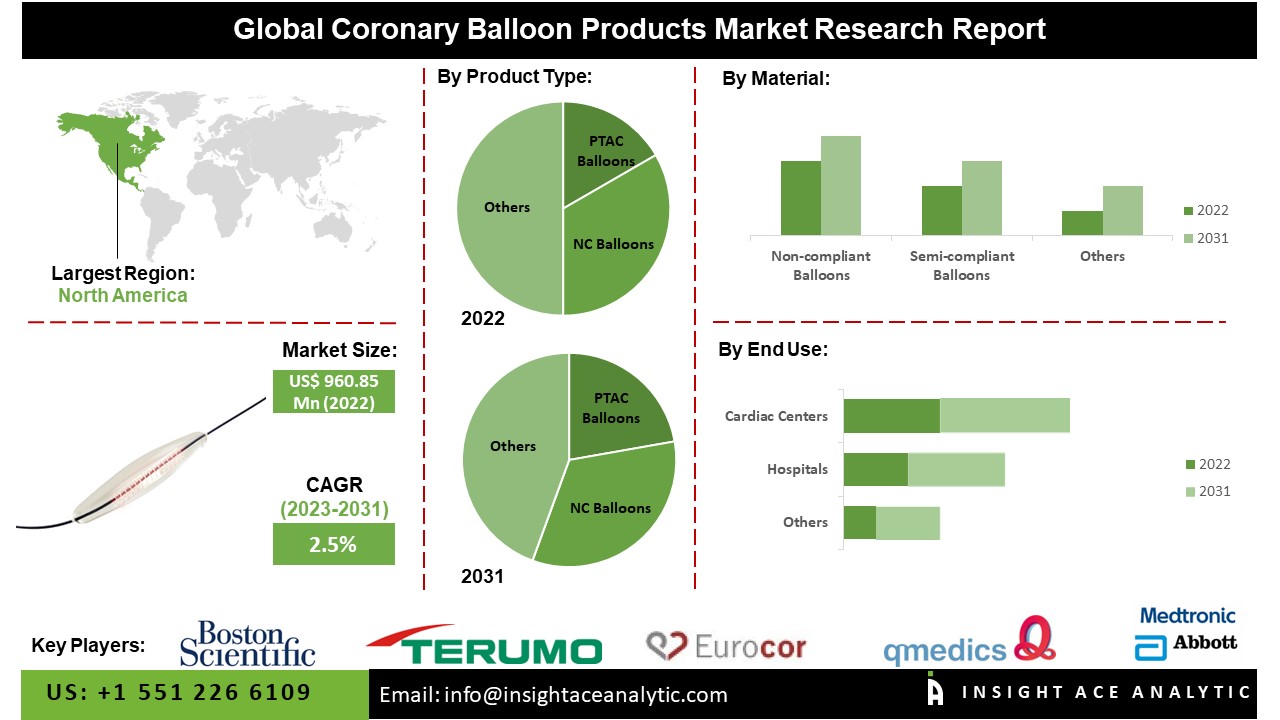
The Coronary Balloon Products Market Size is valued at US$ 960.85 Mn in 2022 and is predicted to reach US$ 1188.30 Mn by the year 2031 at a 2.5 % CAGR during the forecast period for 2023-2031.
Key Industry Insights & Findings from the Report:
- The Coronary Balloon Products market is driven by a combination of factors, including the rising incidence of conditions such as stroke, epilepsy, cerebral aneurysm, arteriovenous malformation (AVM), and carotid artery stenosis. These conditions contribute to an increased demand for effective treatment options.
- The expansion of the Coronary Balloon Products market is being driven by the substantial advancements in micro guidewires technology and the increasing demand for minimally invasive neurosurgery treatments.
- North America dominated the market and accounted for a global revenue share in 2023.
- Market challenges include stringent regulations regarding product approvals and the high cost of balloon catheter procedures.
A balloon catheter is a cutting-edge medical device put into the arm's radial artery or the leg's femoral artery to treat restricted blood arteries. Another minimally invasive technique that uses a balloon catheter is to unblock blocked or constricted coronary arteries brought on by (CAD). Various cardiovascular conditions are treated with a coronary balloon. One of the main drivers of industry growth is the growing geriatric population, which is also boosted by the rising prevalence of cardiovascular disorders and the increased demand for invasive surgical techniques. However, the high cost of angioplasty and the complications that can arise after surgery are expected to hinder market growth.
Furthermore, cardiac catheterization is a diagnostic procedure that allows medical professionals to evaluate a patient's heart's functionality. These trends are anticipated to impact the growth of the market substantially. As the population ages, there will be a tremendous financial demand for old-age support systems. Moreover, some variables, such as autonomic dysregulation, arterial stiffness, the blood-brain barrier, and neurovascular uncoupling, are anticipated to influence the dynamics of local perfusion and brain blood flow with ageing. Long-lasting, cutting-edge catheters are frequently employed to enhance overall quality of life and catheter management in older persons. Older adults are anticipated to utilize coronary balloons, boosting the market.
Competitive Landscape:
Some Major Key Players in The Coronary Balloon Products Market:
- Abbott Laboratories,
- Angiodynamic
- Becton Dickinson
- Biotroni
- Boston Scientific Corporation
- Braun Melsungen AG
- Cook Medical
- Cordis, Endocor GmbH
- Infinity Angioblast balloon
- Johnson & Johnson
- Koninklijke Philips N.V
- Medtronic plc
- Merit Medical System, Inc
- Oscor Inc
- Terumo Corporation.
Market Segmentation:
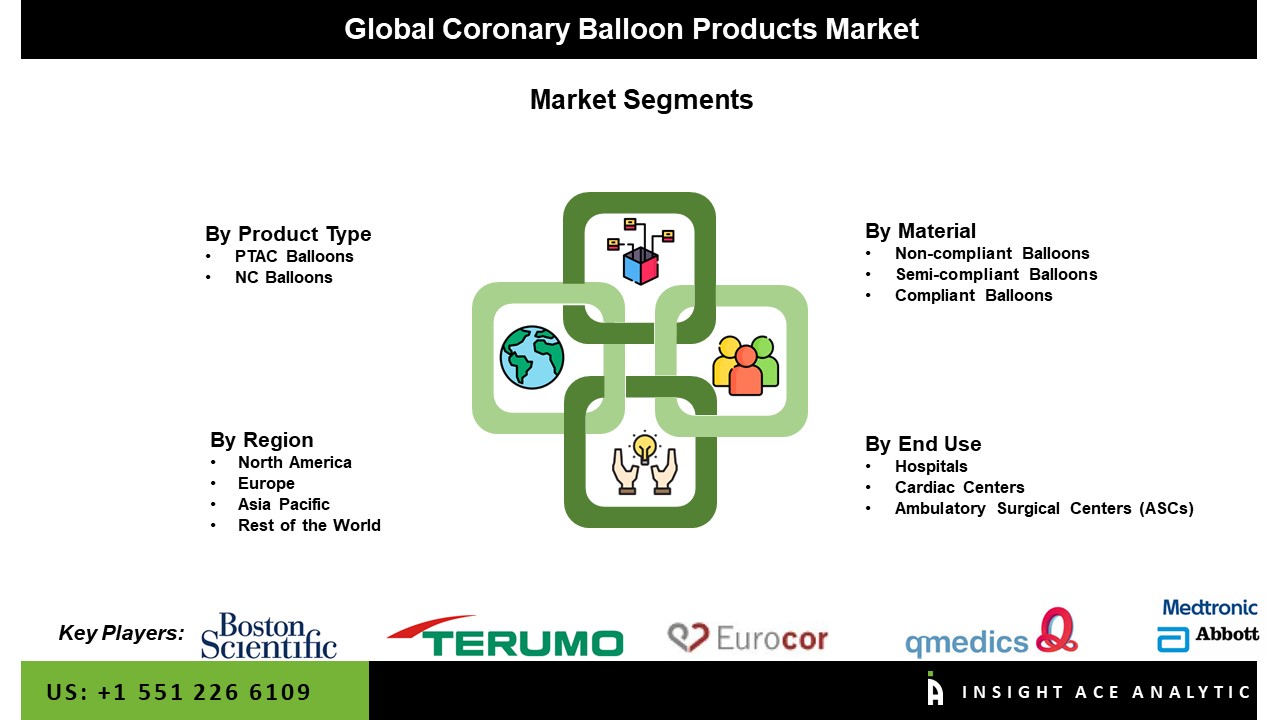
The coronary balloon products market is segmented based on Product, Material And End-Users. Based on the product, the coronary balloon products market is segmented as PTAC balloon and Nc balloon. By material, the market is segmented into non-compliant and semi-compliant. End-user segments the market into hospitals, cardiac centres and ambulatory surgical centres. Based on material, the non-compliant segment is a major contributor to the coronary balloon products market.
The Non-Compliant Category Will Hold A Major Share Of The Global Coronary Balloon Products Market
Compared to non-compliant balloons, compliant balloons are constructed with greater flexibility and conformability to the vessel walls. Due to its flexibility, the balloon can more easily adjust to uneven vessel anatomy and prevent vessel damage while being inflated. Due to the risk of artery wall damage or dissection from non-compliant balloons' high force, they are particularly useful when treating fragile or calcified lesions. Due to their flexibility, compliant balloons can result in better lesion compliance. This characteristic is very valuable when treating complex lesions, bifurcation lesions, and convoluted veins, where accurate dilation is crucial.
The Hospital Segment Witnessed Growth At Tremendous Development
The hospital category is projected to grow rapidly in the global coronary balloon products market. This sector's domination results from developing healthcare infrastructure, expanding the pool of skilled laborers, and affordability. The significant increase in the senior population suffering from lifestyle disorders like atherosclerosis and heart failure is anticipated to broaden the patient base and improve hospital revenue production. More patients choose minimally invasive balloon angioplasty procedures than traditional ones due to the numerous benefits, including less surgical discomfort, injury, scarring, hospital stay, higher accuracy, and quicker recovery times.
The North American Coronary Balloon Products Market Holds A Significant Regional Revenue Share
The North American coronary balloon products market is expected to register the highest market share. The availability of various important manufacturers, the launch of new, technologically advanced equipment, and advantageous reimbursement regulations are all factors. The market is driven by increased diabetes prevalence, government initiatives, and prominent companies' launch of numerous technologically sophisticated products.
In addition, the Asia Pacific regional market is projected to grow rapidly in the global coronary balloon products market. This can be ascribed to a rise in healthcare spending and an increase in the cases of cardiovascular disorders. BioMed central states cardiovascular disease affects one in every five persons in China. Furthermore, it is anticipated that the market in the region will be driven by an aging population in nations like Japan and China and rising disposable income. The expansion of the industry in the area is also aided by the rise of health tourism in emerging countries.
Recent Developments:
- In March 2024, Boston Scientific Corporation disclosed that it has obtained approval from the United States. The AGENT™ Drug-Coated Balloon (DCB) has been granted approval by the FDA for the management of coronary in-stent restenosis (ISR) in individuals diagnosed with coronary artery disease. In-stent restenosis (ISR) is the result of the narrowing or obstruction of a stented blood artery due to the accumulation of plaque or scar tissue.
- In July 2021, Medtronic introduced the Prevail™ drug coated balloon (DCB) Catheter in Europe following the receipt of the CE (Conformité Européene) designation. The recently created Prevail DCB, a drug-coated balloon (DCB) specifically designed for percutaneous coronary intervention (PCI), is utilized to treat stenotic or occluded coronary arteries in persons diagnosed with coronary artery disease (CAD).
Coronary Balloon Products Market Report Scope:
| Report Attribute | Specifications |
| Market Size Value In 2022 | USD 960.85 Mn |
| Revenue Forecast In 2031 | USD 1188.30 Mn |
| Growth Rate CAGR | CAGR of 2.5 % from 2023 to 2031 |
| Quantitative Units | Representation of revenue in US$ Million and CAGR from 2023 to 2031 |
| Historic Year | 2019 to 2022 |
| Forecast Year | 2023-2031 |
| Report Coverage | The forecast of revenue, the position of the company, the competitive market structure, growth prospects, and trends |
| Segments Covered | By Technology, By Material, By Component |
| Regional Scope | North America; Europe; Asia Pacific; Latin America; Middle East & Africa |
| Country Scope | U.S.; Canada; U.K.; Germany; China; India; Japan; Brazil; Mexico; The UK; France; Italy; Spain; China; Japan; India; South Korea; Southeast Asia; South Korea; South East Asia. |
| Competitive Landscape | Abbott Laboratories, Angio Dynamic, Becton Dickinson, Bortnick, Boston Scientific Corporation, Braun Melungeon AG, Cook Medical, Cordis, Endocon GmbH, Infinity Angioblast balloon, Johnson & Johnson, Koninklijke Philips N.V., Medtronic plc, Merit Medical System, Inc, Oscar Inc, Terumo Corporation and others. |
| Customization Scope | Free customization report with the procurement of the report, Modifications to the regional and segment scope. Particular Geographic competitive landscape. |
| Pricing And Available Payment Methods | Explore pricing alternatives that are customized to your particular study requirements. |
Segmentation of Coronary Balloon Products Market-
Coronary Balloon Products Market By Product-
- PTAC balloon
- Nc balloon
Coronary Balloon Products Market By Material-
- Compliant Balloons
- Non-Compliant
- Semi-Compliant
Coronary Balloon Products Market By End-User
- Hospitals
- Cardiac Centers
- Ambulatory Surgical Centers
Coronary Balloon Products Market By Region-
North America-
- The US
- Canada
- Mexico
Europe-
- Germany
- The UK
- France
- Italy
- Spain
- Rest of Europe
Asia-Pacific-
- China
- Japan
- India
- South Korea
- Southeast Asia
- Rest of Asia Pacific
Latin America-
- Brazil
- Argentina
- Rest of Latin America
Middle East & Africa-
- GCC Countries
- South Africa
- Rest of Middle East and Africa
Research Design and Approach
This study employed a multi-step, mixed-method research approach that integrates:
- Secondary research
- Primary research
- Data triangulation
- Hybrid top-down and bottom-up modelling
- Forecasting and scenario analysis
This approach ensures a balanced and validated understanding of both macro- and micro-level market factors influencing the market.
Secondary Research
Secondary research for this study involved the collection, review, and analysis of publicly available and paid data sources to build the initial fact base, understand historical market behaviour, identify data gaps, and refine the hypotheses for primary research.
Sources Consulted
Secondary data for the market study was gathered from multiple credible sources, including:
- Government databases, regulatory bodies, and public institutions
- International organizations (WHO, OECD, IMF, World Bank, etc.)
- Commercial and paid databases
- Industry associations, trade publications, and technical journals
- Company annual reports, investor presentations, press releases, and SEC filings
- Academic research papers, patents, and scientific literature
- Previous market research publications and syndicated reports
These sources were used to compile historical data, market volumes/prices, industry trends, technological developments, and competitive insights.

Primary Research
Primary research was conducted to validate secondary data, understand real-time market dynamics, capture price points and adoption trends, and verify the assumptions used in the market modelling.
Stakeholders Interviewed
Primary interviews for this study involved:
- Manufacturers and suppliers in the market value chain
- Distributors, channel partners, and integrators
- End-users / customers (e.g., hospitals, labs, enterprises, consumers, etc., depending on the market)
- Industry experts, technology specialists, consultants, and regulatory professionals
- Senior executives (CEOs, CTOs, VPs, Directors) and product managers
Interview Process
Interviews were conducted via:
- Structured and semi-structured questionnaires
- Telephonic and video interactions
- Email correspondences
- Expert consultation sessions
Primary insights were incorporated into demand modelling, pricing analysis, technology evaluation, and market share estimation.
Data Processing, Normalization, and Validation
All collected data were processed and normalized to ensure consistency and comparability across regions and time frames.
The data validation process included:
- Standardization of units (currency conversions, volume units, inflation adjustments)
- Cross-verification of data points across multiple secondary sources
- Normalization of inconsistent datasets
- Identification and resolution of data gaps
- Outlier detection and removal through algorithmic and manual checks
- Plausibility and coherence checks across segments and geographies
This ensured that the dataset used for modelling was clean, robust, and reliable.
Market Size Estimation and Data Triangulation
Bottom-Up Approach
The bottom-up approach involved aggregating segment-level data, such as:
- Company revenues
- Product-level sales
- Installed base/usage volumes
- Adoption and penetration rates
- Pricing analysis
This method was primarily used when detailed micro-level market data were available.

Top-Down Approach
The top-down approach used macro-level indicators:
- Parent market benchmarks
- Global/regional industry trends
- Economic indicators (GDP, demographics, spending patterns)
- Penetration and usage ratios
This approach was used for segments where granular data were limited or inconsistent.
Hybrid Triangulation Approach
To ensure accuracy, a triangulated hybrid model was used. This included:
- Reconciling top-down and bottom-up estimates
- Cross-checking revenues, volumes, and pricing assumptions
- Incorporating expert insights to validate segment splits and adoption rates
This multi-angle validation yielded the final market size.
Forecasting Framework and Scenario Modelling
Market forecasts were developed using a combination of time-series modelling, adoption curve analysis, and driver-based forecasting tools.
Forecasting Methods
- Time-series modelling
- S-curve and diffusion models (for emerging technologies)
- Driver-based forecasting (GDP, disposable income, adoption rates, regulatory changes)
- Price elasticity models
- Market maturity and lifecycle-based projections
Scenario Analysis
Given inherent uncertainties, three scenarios were constructed:
- Base-Case Scenario: Expected trajectory under current conditions
- Optimistic Scenario: High adoption, favourable regulation, strong economic tailwinds
- Conservative Scenario: Slow adoption, regulatory delays, economic constraints
Sensitivity testing was conducted on key variables, including pricing, demand elasticity, and regional adoption.
Request Customization
Add countries, segments, company profiles, or extend forecast — free 10% customization with purchase.
Customize This Report →Enquire Before Buying
Speak with our analyst team about scope, methodology, pricing, or deliverable formats.
Enquire Now →Frequently Asked Questions
Coronary Balloon Products Market Size is valued at US$ 960.85 Mn in 2022 and is predicted to reach US$ 1188.30 Mn by the year 2031
Coronary Balloon Products Market expected to grow at a 2.5 % CAGR during the forecast period for 2023-2031
Abbott Laboratories, Angio Dynamic, Becton Dickinson, Bortnick, Boston Scientific Corporation, Braun Melungeon AG, Cook Medical, Cordis, Endocon GmbH,