Circular Economy in the Beverage Industry Market Size, Share & Trends Analysis by Material Type (Plastic (PET, rPET, biodegradable), Glass. Aluminum, Paper/Cardboard, Emerging Materials (biodegradable, edible)), Product Category (Carbonated Soft Drinks, Alcoholic Beverages, Juices and Non-Carbonated Drinks, Water, Coffee and Tea), Business Model (Product-as-a-Service, Product Life Extension, Resource Recovery and Upcycling, Sharing Models) and Segment Forecasts, 2025-2034
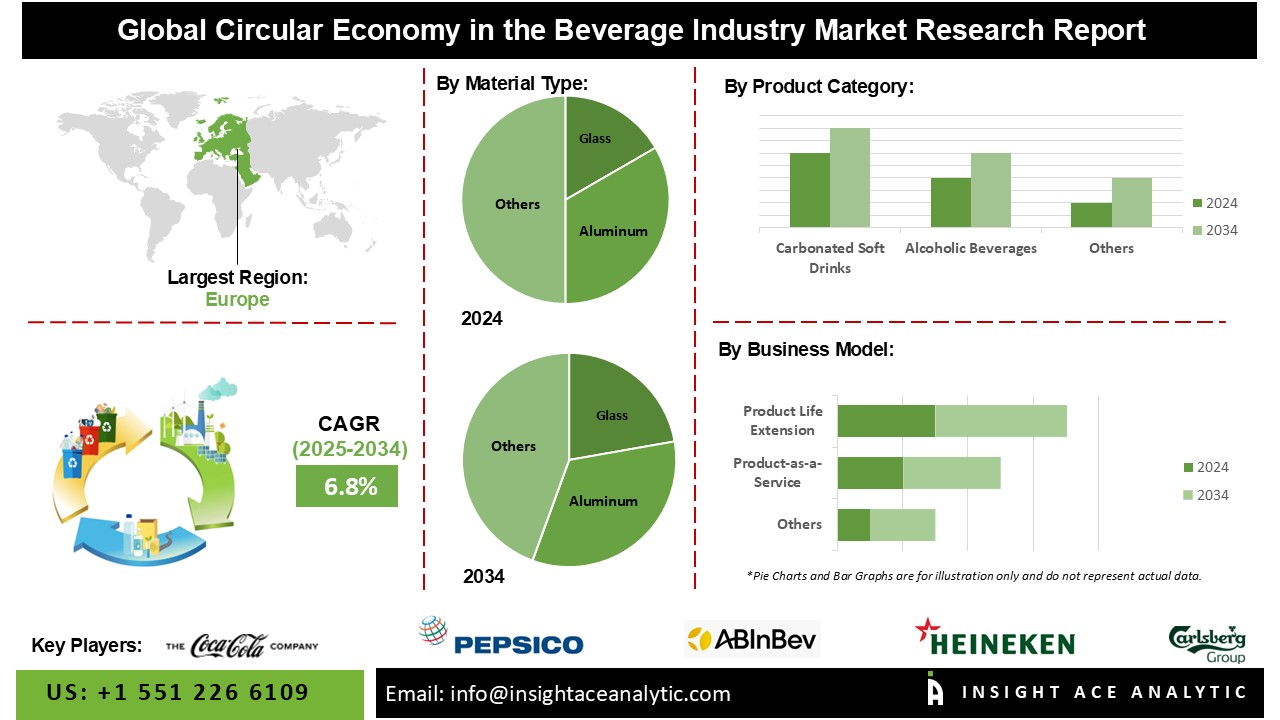
Global Circular Economy in the Beverage Industry Market Size is predicted to grow at an 6.8% CAGR during the forecast period for 2025-2034.
The beverage circular economy is a move away from the conventional linear model of "take-make-dispose" to a sustainable system that is centered on minimizing waste and maximizing resource efficiency. It entails reasoning diversely about how beverages are produced, packaged, and consumed so that materials such as bottles and cans are reused or recycled instead of being discarded. Key initiatives include using recyclable, reusable, or compostable packaging, such as recycled PET (rPET) bottles and plant-based bioplastics.
Furthermore, the industry is recycling byproducts such as discarded grains from brewing or fruit pulp into bioenergy, animal feed, or even cosmetic ingredients, as seen by programs such as Anheuser-Busch's EverGrain program. This method aims to reduce environmental effects while retaining economic viability, spurred by increased customer demand for eco-friendly practices and rigid regulatory frameworks.
Applying circular economy principles provides the beverage industry with various advantages. On an environmental level, it reduces plastic pollution, carbon footprint, and dependence on virgin materials. Economically, it saves on material and waste disposal costs, creates new revenue streams via waste valorization, and promotes innovation. It also meets growing consumer demand for sustainable products and helps to meet more stringent regulations. Yet, limitations in recycling infrastructure and the expense of sustainable materials and technology, especially for smaller companies, may slow widespread take-up.
Competitive Landscape
Some of the key players in circular economy in the beverage Industry market:
• The Coca-Cola Company
• PepsiCo
• Anheuser-Busch InBev
• Heineken
• Carlsberg
• Diageo
• Suntory Holdings
• Nestlé (Nestlé Waters)
• Keurig Dr Pepper
• Unilever
• Danone
• Asahi Group Holdings
• Loop (TerraCycle)
• Notpla
• Reborn
• Blue Ocean Closures
• Toast Ale
• Rubies in the Rubble
• In The Welsh Wind
• Mimica
Market Segmentation:
The circular economy in the Beverage Industry is segmented by material type, product, category, business model. By material type, the market is segmented into plastic (PET, rpet, biodegradable), glass, aluminum, paper/cardboard, emerging materials (biodegradable, edible). By product category is segmented into carbonated soft drinks, alcoholic beverages, juices and non-carbonated drinks, water, coffee and tea. By business model market is segmented into product-as-a-service, product life extension, resource recovery and upcycling, sharing models.
Plastic (PET, rPET, biodegradable) Segment is Expected to Drive the Circular Economy in the Beverage Market
Plastic, and especially PET (Polyethylene Terephthalate) and recycled PET (rPET), takes the lead in the circular economy drive within the beverage sector owing to its excellent recyclability, light weight, and reduced energy and water use in production when compared to alternatives. PET enables innovations such as label-free and mono-material packaging, which maximize recycling efficiency and minimize contamination. Most drink manufacturers are ramping up their utilization of rPET to close the loop on plastic waste, even though recycling rates are still working in progress. Although biodegradable and plant-based plastics are becoming sustainable alternatives, they are not yet at the scalability and infrastructure backing of PET packaging.
Carbonated Soft Drinks is Growing at the Highest Rate in the Circular Economy in the Beverage Market.
Carbonated soft drinks are leading circular economy growth in the beverage industry due to strong sustainability efforts, a shift to refillable packaging, and growing pressure from consumers and regulators. Companies such as Coca-Cola and San Benedetto are incorporating 100% recycled PET bottles and investing in carbon-neutral technologies. Reusable PET bottles (Ref-PET), which must be altered within the supply chain, are picking up strength. Meanwhile, demand for eco-friendly products and stricter regulations are driving innovations like lightweighting, clear plastics, and higher recycled content.
Regionally, Europe Led the Circular Economy in the Beverage Market.
The EU is driving the circular economy transition in the beverage sector with firm policy and industry action. Its Circular Economy Action Plan and legislation such as the Packaging and Packaging Waste Regulation (PPWR) include recycled content requirements and encourage recyclable, reusable, or compostable packaging. Deposit Return Schemes (DRS), observed in nations such as Malta, increase recycling and lower litter. The EU also promotes industrial symbiosis and bioeconomy projects, converting waste from the beverage industry into inputs for bio-based packaging and other renewable purposes, strengthening the closed-loop system.
Circular Economy in the Beverage Industry Market Report Scope:
| Report Attribute | Specifications |
| Growth Rate CAGR | CAGR of 6.8% from 2025 to 2034 |
| Quantitative Units | Representation of revenue in US$ Mn and CAGR from 2025 to 2034 |
| Historic Year | 2021 to 2024 |
| Forecast Year | 2025-2034 |
| Report Coverage | The forecast of revenue, the position of the company, the competitive market structure, growth prospects, and trends |
| Segments Covered | By Material Type, Product, Category, Business Model and By Region |
| Regional Scope | North America; Europe; Asia Pacific; Latin America; Middle East & Africa |
| Country Scope | U.S.; Canada; U.K.; Germany; Brazil; Mexico; The UK; France; Italy; Spain; China; Japan; India; South Korea |
| Competitive Landscape | Nordkalk, Mississippi Lime Company, Carmeuse, ARA Chemie, Cornelissen Group, Lhoist Group, Nirma Limited, Omya AG, Matsusaka Limestone Co., United States Lime and Minerals, Illinois Lime Company, PPC Ltd., and Graymont. |
| Customization Scope | Free customization report with the procurement of the report, Modifications to the regional and segment scope. Geographic competitive landscape. |
| Pricing and Available Payment Methods | Explore pricing alternatives that are customized to your particular study requirements. |
Segmentation of Circular Economy in the Beverage Industry Market -
Circular Economy in the Beverage Market by Material Type -
• Plastic (PET, rPET, biodegradable)
• Glass
• Aluminum
• Paper/Cardboard
• Emerging Materials (biodegradable, edible)
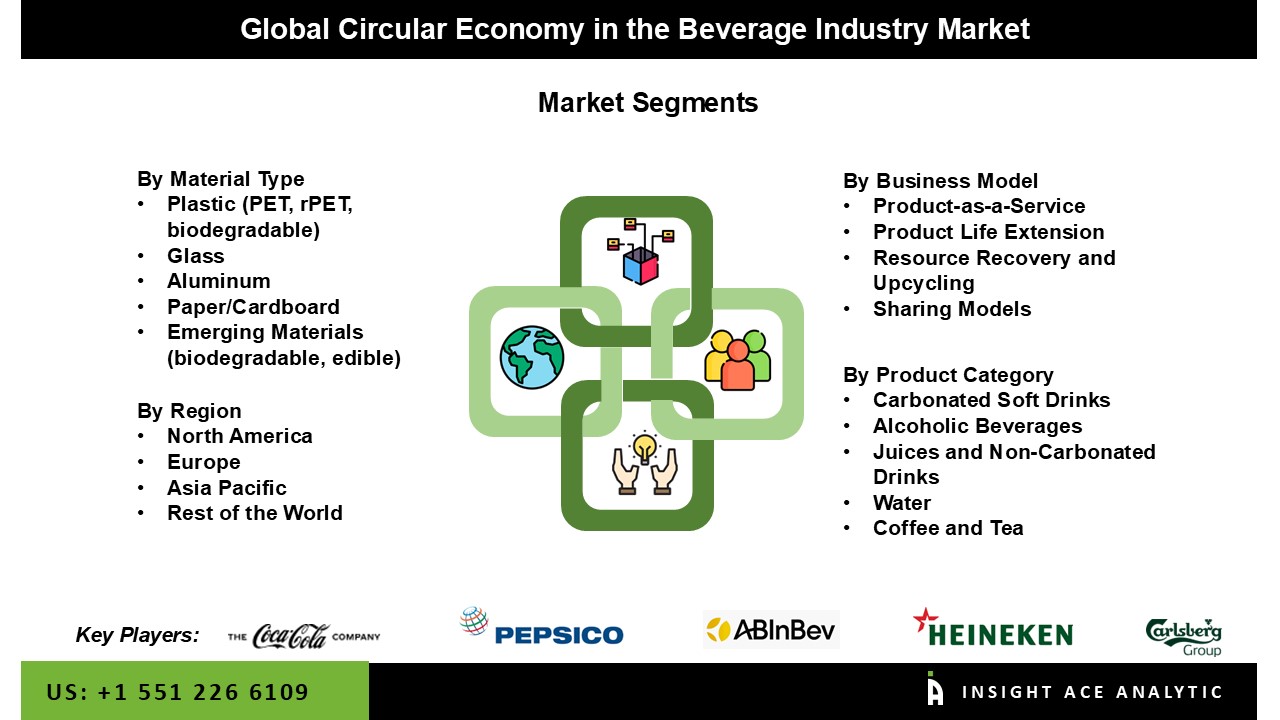
Circular Economy in the Beverage Market by Product Category -
• Carbonated Soft Drinks
• Alcoholic Beverages
• Juices and Non-Carbonated Drinks
• Water
• Coffee and Tea
Circular Economy in the Beverage Market by Business Model-
• Product-as-a-Service
• Product Life Extension
• Resource Recovery and Upcycling
• Sharing Models
Circular Economy in the Beverage Market by Region-
North America-
• The US
• Canada
Europe-
• Germany
• The UK
• France
• Italy
• Spain
• Rest of Europe
Asia-Pacific-
• China
• Japan
• India
• South Korea
• Southeast Asia
• Rest of Asia Pacific
Latin America-
• Brazil
• Argentina
• Mexico
• Rest of Latin America
Middle East & Africa-
• GCC Countries
• South Africa
• Rest of the Middle East and Africa
Research Design and Approach
This study employed a multi-step, mixed-method research approach that integrates:
- Secondary research
- Primary research
- Data triangulation
- Hybrid top-down and bottom-up modelling
- Forecasting and scenario analysis
This approach ensures a balanced and validated understanding of both macro- and micro-level market factors influencing the market.
Secondary Research
Secondary research for this study involved the collection, review, and analysis of publicly available and paid data sources to build the initial fact base, understand historical market behaviour, identify data gaps, and refine the hypotheses for primary research.
Sources Consulted
Secondary data for the market study was gathered from multiple credible sources, including:
- Government databases, regulatory bodies, and public institutions
- International organizations (WHO, OECD, IMF, World Bank, etc.)
- Commercial and paid databases
- Industry associations, trade publications, and technical journals
- Company annual reports, investor presentations, press releases, and SEC filings
- Academic research papers, patents, and scientific literature
- Previous market research publications and syndicated reports
These sources were used to compile historical data, market volumes/prices, industry trends, technological developments, and competitive insights.

Primary Research
Primary research was conducted to validate secondary data, understand real-time market dynamics, capture price points and adoption trends, and verify the assumptions used in the market modelling.
Stakeholders Interviewed
Primary interviews for this study involved:
- Manufacturers and suppliers in the market value chain
- Distributors, channel partners, and integrators
- End-users / customers (e.g., hospitals, labs, enterprises, consumers, etc., depending on the market)
- Industry experts, technology specialists, consultants, and regulatory professionals
- Senior executives (CEOs, CTOs, VPs, Directors) and product managers
Interview Process
Interviews were conducted via:
- Structured and semi-structured questionnaires
- Telephonic and video interactions
- Email correspondences
- Expert consultation sessions
Primary insights were incorporated into demand modelling, pricing analysis, technology evaluation, and market share estimation.
Data Processing, Normalization, and Validation
All collected data were processed and normalized to ensure consistency and comparability across regions and time frames.
The data validation process included:
- Standardization of units (currency conversions, volume units, inflation adjustments)
- Cross-verification of data points across multiple secondary sources
- Normalization of inconsistent datasets
- Identification and resolution of data gaps
- Outlier detection and removal through algorithmic and manual checks
- Plausibility and coherence checks across segments and geographies
This ensured that the dataset used for modelling was clean, robust, and reliable.
Market Size Estimation and Data Triangulation
Bottom-Up Approach
The bottom-up approach involved aggregating segment-level data, such as:
- Company revenues
- Product-level sales
- Installed base/usage volumes
- Adoption and penetration rates
- Pricing analysis
This method was primarily used when detailed micro-level market data were available.

Top-Down Approach
The top-down approach used macro-level indicators:
- Parent market benchmarks
- Global/regional industry trends
- Economic indicators (GDP, demographics, spending patterns)
- Penetration and usage ratios
This approach was used for segments where granular data were limited or inconsistent.
Hybrid Triangulation Approach
To ensure accuracy, a triangulated hybrid model was used. This included:
- Reconciling top-down and bottom-up estimates
- Cross-checking revenues, volumes, and pricing assumptions
- Incorporating expert insights to validate segment splits and adoption rates
This multi-angle validation yielded the final market size.
Forecasting Framework and Scenario Modelling
Market forecasts were developed using a combination of time-series modelling, adoption curve analysis, and driver-based forecasting tools.
Forecasting Methods
- Time-series modelling
- S-curve and diffusion models (for emerging technologies)
- Driver-based forecasting (GDP, disposable income, adoption rates, regulatory changes)
- Price elasticity models
- Market maturity and lifecycle-based projections
Scenario Analysis
Given inherent uncertainties, three scenarios were constructed:
- Base-Case Scenario: Expected trajectory under current conditions
- Optimistic Scenario: High adoption, favourable regulation, strong economic tailwinds
- Conservative Scenario: Slow adoption, regulatory delays, economic constraints
Sensitivity testing was conducted on key variables, including pricing, demand elasticity, and regional adoption.
Request Customization
Add countries, segments, company profiles, or extend forecast — free 10% customization with purchase.
Customize This Report →Enquire Before Buying
Speak with our analyst team about scope, methodology, pricing, or deliverable formats.
Enquire Now →Frequently Asked Questions
Circular Economy in the Beverage Industry Market Size is predicted to grow at an 6.8% CAGR during the forecast period for 2025-2034.
Nordkalk, Mississippi Lime Company, Carmeuse, ARA Chemie, Cornelissen Group, Lhoist Group, Nirma Limited, Omya AG, Matsusaka Limestone Co., United Sta
Circular economy in the Beverage Industry Market is segmented by material type, product, category, business model.
Europe region is leading the Circular economy in the Beverage Industry Market.