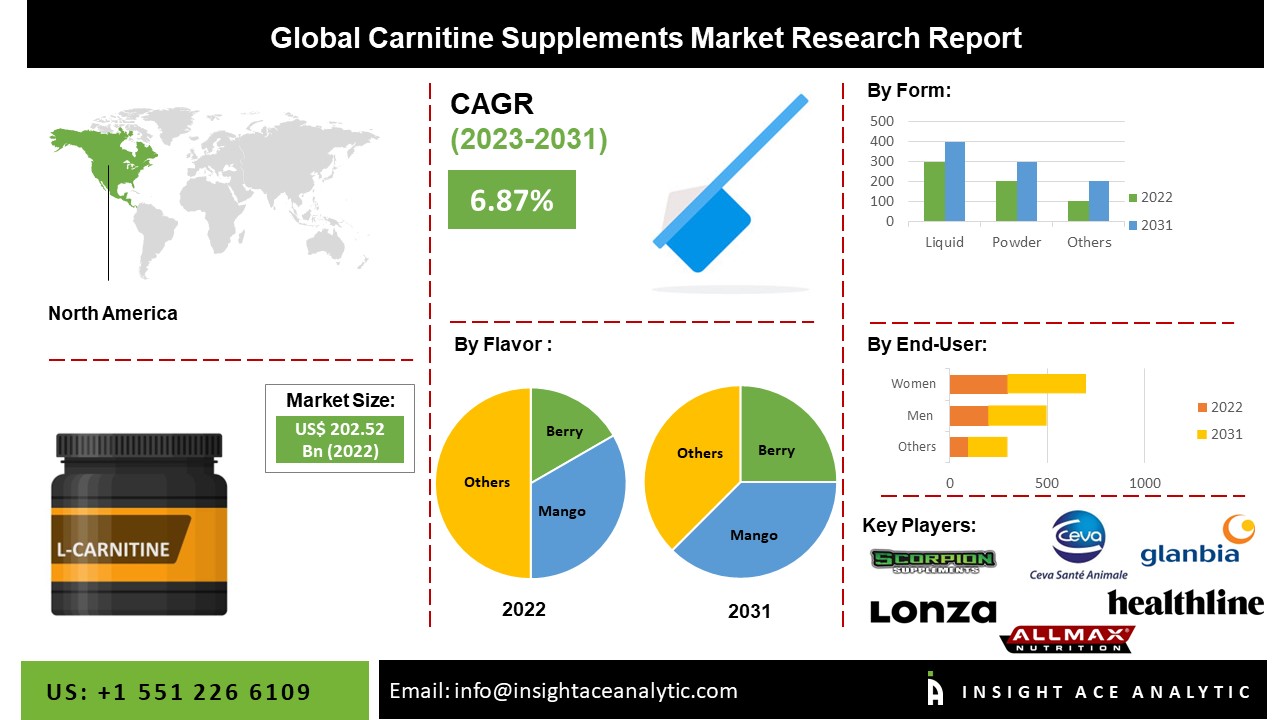
The Carnitine Supplements Market Size is valued at 202.52 billion in 2022 and is predicted to reach 362.49 billion by the year 2031 at a 6.87% CAGR during the forecast period for 2023-2031.
Carnitine is a dietary supplement manufactured from a naturally occurring derivative of an amino acid. It's a weight-loss supplement that may potentially have an impact on how the brain works. The human brain, liver, and kidneys all manufacture the L-carnitine chemical, which facilitates the body's process of turning fat into energy. Carnitine is used as a supplement by those whose bodies don't synthesize enough.
Additionally, the market for L-carnitine supplements is being propelled forward by patients' increased knowledge of the various diseases' treatments. The need for L-carnitine supplements is being boosted by unhealthy lifestyle choices, a growing senior population worldwide, and obesity-related illnesses like chronic fatigue, diabetes, and heart attacks. The increasing usage of L-carnitine supplements for post-exercise recovery, weight control, and healthy ageing is also driving the market ahead.
In addition, there are prospects in the market for L-carnitine supplements due to improved raw material manufacturing efficiency, low labour costs, and a shortage of manpower. Some potential and encouraging market trends for L-carnitine supplements are promoting market expansion. The market is home to some well-known companies that are vying with one another for greater sales and exposure.
Recent Developments:
- In February 2022, the newly created L-carnitine sports drink will be available, according to the United Kingdom-based sports nutrition company Applied Nutrition Ltd. Carni-Tone, the first flavour-infused spring water produced by the company, broadens its assortment of RTD products. The company's first L-Carnitine RTD beverage has been developing since the beginning of last year (a substance that improves energy metabolism).
- In October 2019, MuscleGuard, a new product made with vegan ingredients, was introduced by Lonza. The supplement is a proprietary combination of L-carnitine, Leucine, Creatine, and vitamin D.
Competitive Landscape :
Global Carnitine market players include:
- 1 Up Nutrition
- Advanced Orthomolecular Research
- Alumax Nutrition, Inc.
- Biosint S.p.A.
- Cayman Chemical
- Ceva Santé Animale S.A.
- ChengDa Mediciness Co., Ltd.
- Designs for Health, Inc.
- Eat Me Supplements
- Glanbia PLC
- GNC Holdings, LLC
- Healthline Media, Inc.
- Huanggang Huayang Medicines Co. Ltd.
- HuBeiYuancheng Saichuang Technology Co, Ltd.
- Kaiyuan Hengtai Chemical Co., Ltd
- Lonza Group Ltd.
- Merck KGaA
- Northeast Pharmaceutical Group Co., Ltd.
- now foods
- Scorpion Supplements
- squared Brands, LLC
- Tokyo Chemical Industry Co., Ltd.
Market Segmentation:
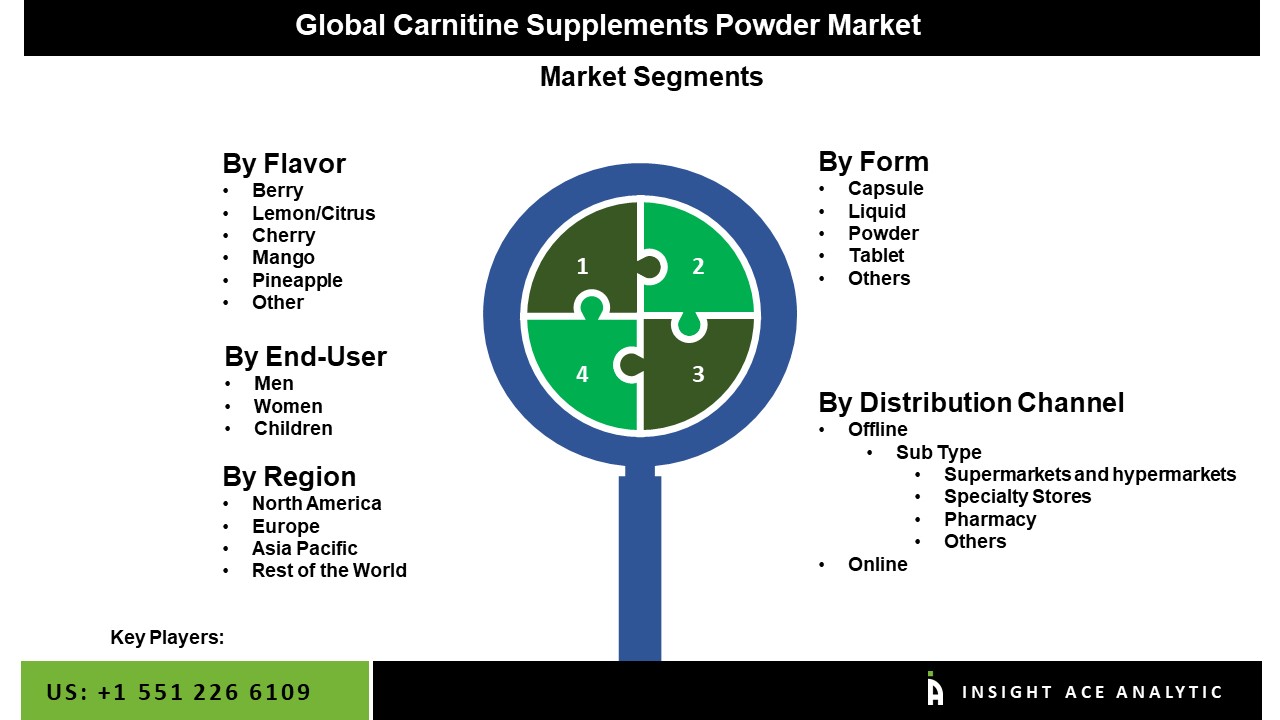
The market for carnitine supplements is divided into segments based on flavour, form, end user, and distribution method. The market is divided into the berry, lemon/citrus, cherry, mango, pineapple, and other categories based on flavour. It is divided into the capsule, liquid, powder, tablet, and other forms according to form. The market is classified into three categories based on the end user: males, women, and children. The market is split into two segments based on the distribution channel: offline and online. Supermarkets, hypermarkets, specialty shops, pharmacies, and other establishments make up the offline distribution channel.
The Liquid Category Accounted For The Majority Of Sales Of Carnitine Supplements
According to the market trends for carnitine supplements, the liquid segment was the biggest one in 2021. Liquid supplements are more effective than those that come in tablet or capsule form. The liquid carnitine supplements are also easy to digest because they contain delectable fruity scents. Expansion in the number of health-conscious consumers worldwide, an increase in consumer spending on health and wellness, and an overall rise in the prevalence of obesity and overweight, excess weight gain globally are the main factors anticipated to propel the growth of liquid carnitine supplements during the forecast period.
As cases of childhood malnutrition rise, there will likely be an increased requirement for liquid carnitine supplementation. According to the World Health Organization (WHO), malnutrition impacted over 155 million people in 2016 children under the age of five. Additionally, throughout the projected period, the market growth is anticipated to be significantly boosted by the increased use of liquid carnitine supplements for baby nutrition.
The Online Category Is Anticipated To Experience The Quickest Growth Across All Distribution Channels During The Forecasted Timeframe
The fastest-growing distribution channel for carnitine supplements is anticipated to be online over the forecast period, according to market trends based on the distribution channel. The fast availability of carnitine supplements and benefits provided by online portals, such as information on the functional properties of the goods, offers, and usage instructions, is credited with the expansion of the online sales channel. Additionally, internet merchants' ease in offering customers home delivery and time-saving tools drives industry growth. Furthermore, the development of internet portals in both developed and developing nations and the rise in offers and discounts are luring customers to buy carnitine supplements online. Customers are lured into purchasing carnitine supplements via Internet channels because of the
The Region With The Highest Growth Projections Is Asia Pacific
North America's largest regional market for brain health supplements will hold a significant market in 2021. Growth in the market in North America is being driven by a strong desire to improve brain function among adults, a more substantial baby boomer generation, and easy access to high-quality goods. Besides, Asia Pacific is anticipated to see the highest growth throughout the course of the projection period due to its populous nations, expanding foreign investment working with local companies, economic development, and rising consumer awareness in the upper-middle income sector.
Carnitine Supplements Market Report Scope:
|
Report Attribute
|
Specifications
|
|
Market size value in 2022
|
USD 202.52 Mn
|
|
Revenue forecast in 2031
|
USD 362.49 Mn
|
|
Growth rate CAGR
|
CAGR of 6.87 % from 2023 to 2031
|
|
Quantitative units
|
Representation of revenue in US$ Billion, and CAGR from 2023 to 2031
|
|
Historic Year
|
2019 to 2022
|
|
Forecast Year
|
2023-2031
|
|
Report coverage
|
The forecast of revenue, the position of the company, the competitive market statistics, growth prospects, and trends
|
|
Segments covered
|
Product And Application
|
|
Regional scope
|
North America; Europe; Asia Pacific; Latin America; Middle East & Africa
|
|
Country scope
|
U.S.; Canada; U.K.; Germany; China; India; Japan; Brazil; Mexico; The UK; France; Italy; Spain; China; Japan; India; South Korea; Southeast Asia; South Korea; Southeast Asia
|
|
Competitive Landscape
|
Biosint S.p.A., Cayman Chemical, ChengDa PharmaCeuticals Co., Ltd., Ceva, HuBeiYuancheng SaichuangTechnology Co., Ltd., Huanggang Huayang Pharmaceutical Co. Ltd., Kaiyuan Hengtai Nutrition Co., Ltd., Lonza, Merck KGaA, Northeast Pharmaceutical Group Co.
|
|
Customization scope
|
Free customization report with the procurement of the report, Modifications to the regional and segment scope. Particular Geographic competitive landscape.
|
|
Pricing and available payment methods
|
Explore pricing alternatives that are customized to your particular study requirements.
|
Segmentation of Carnitine Supplements Market
Carnitine Supplements Market By Flavour
- Berry
- Lemon/Citrus
- Cherry
- Mango
- Pineapple
- Others
Carnitine Supplements Market By Form
- Capsule
- Liquid
- Powder
- Tablet
- Others
Carnitine Supplements Market By End User
Carnitine Supplements Market By Distribution Channel
- Offline
- Supermarkets and hypermarkets
- Specialty Stores
- Pharmacy
- Others
- Online
Carnitine Supplements Market By Region scope
North America-
Europe-
- Germany
- The UK
- France
- Italy
- Spain
- Rest of Europe
Asia-Pacific-
- China
- Japan
- India
- South Korea
- South East Asia
- Rest of Asia Pacific
Latin America-
- Brazil
- Argentina
- Rest of Latin America
Middle East & Africa-
- GCC Countries
- South Africa
- Rest of the Middle East and Africa