



Global Alcohol-Infused Ice Cream Market Size is valued at USD 939.8 Million in 2024 and is predicted to reach USD 2287.3 Million by the year 2034 at an 9.5% CAGR during the forecast period for 2025-2034.
Key Industry Insights & Findings from the Report:
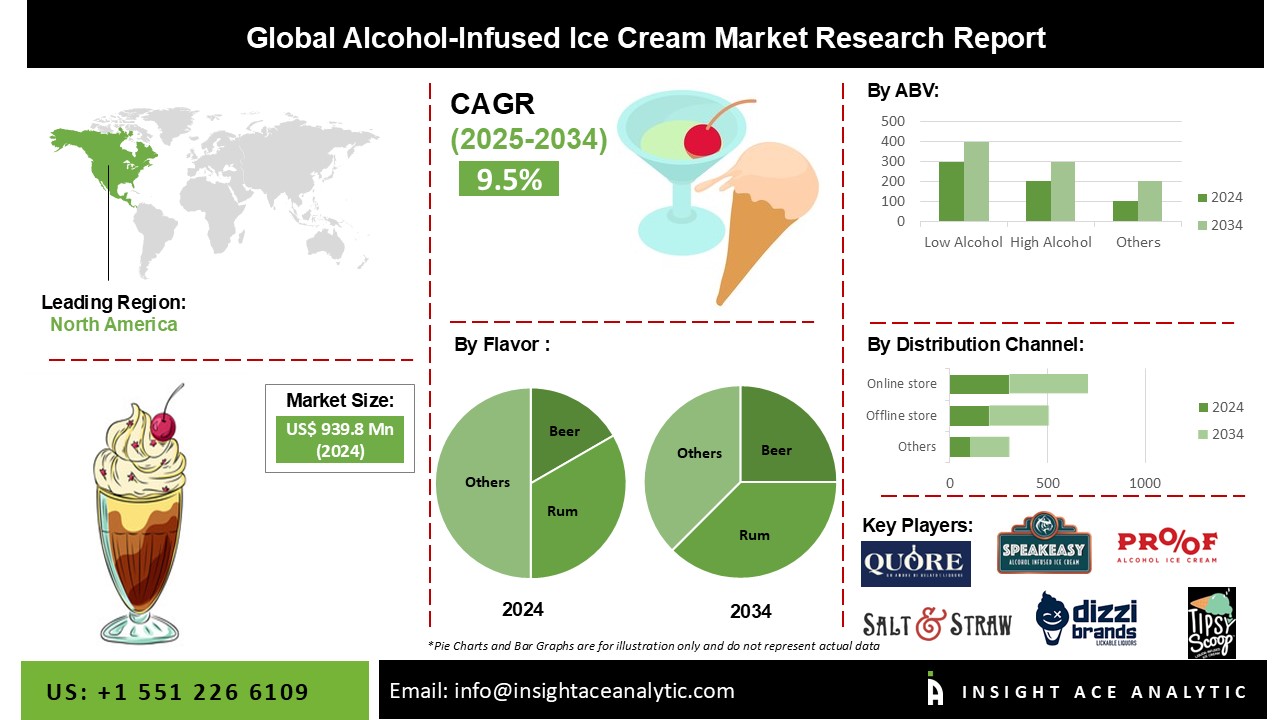
A confectionary item, "alcohol-infused ice cream," is created by combining ice cream and alcohol. Alcohol-infused ice cream is becoming increasingly popular since it offers sweetness and a mild buzz. Alcohol-infused ice cream is made using a range of alcoholic beverages, including beer, rum, whiskey, and others. Alcohol-infused ice cream is a recent fad on the international market, and businesses that produce it are getting a lot of good reviews from customers.
Additionally, manufacturers are concentrating on experimenting with novel flavors to give their customers various options. The most popular flavors of alcohol-infused ice cream include chocolate whiskey, lemon, salted honey, and salted vanilla. The global alcohol-infused ice cream market has increased due to the rising demand for alcohol-infused products. Ice cream manufacturers were motivated to introduce alcohol to the market by consumer desire for distinctive flavors. During the projected period, this aspect is anticipated to fuel the expansion of the market for alcohol-infused ice cream.
Moreover, with the help of a recent invention called alcohol-infused ice cream, customers may now indulge in their preferred alcoholic beverage outside of pubs and eateries. When participating in outdoor activities like picnics and camping trips, customers can benefit from the product's availability in a range of package sizes, which is one of the main elements driving the growth of the alcohol-infused ice cream market.
In September 2022, The Bridge2AI program was created by the NIH, with the goal of engaging people from diverse groups and providing a range of tools, resources, and data to facilitate the development of an AI strategy.
In February 2022, Qureight secured a seed investment of USD 1.50 million for its AI-powered platform, which effectively decreased drug expenses by accelerating clinical trials and shortening their duration.
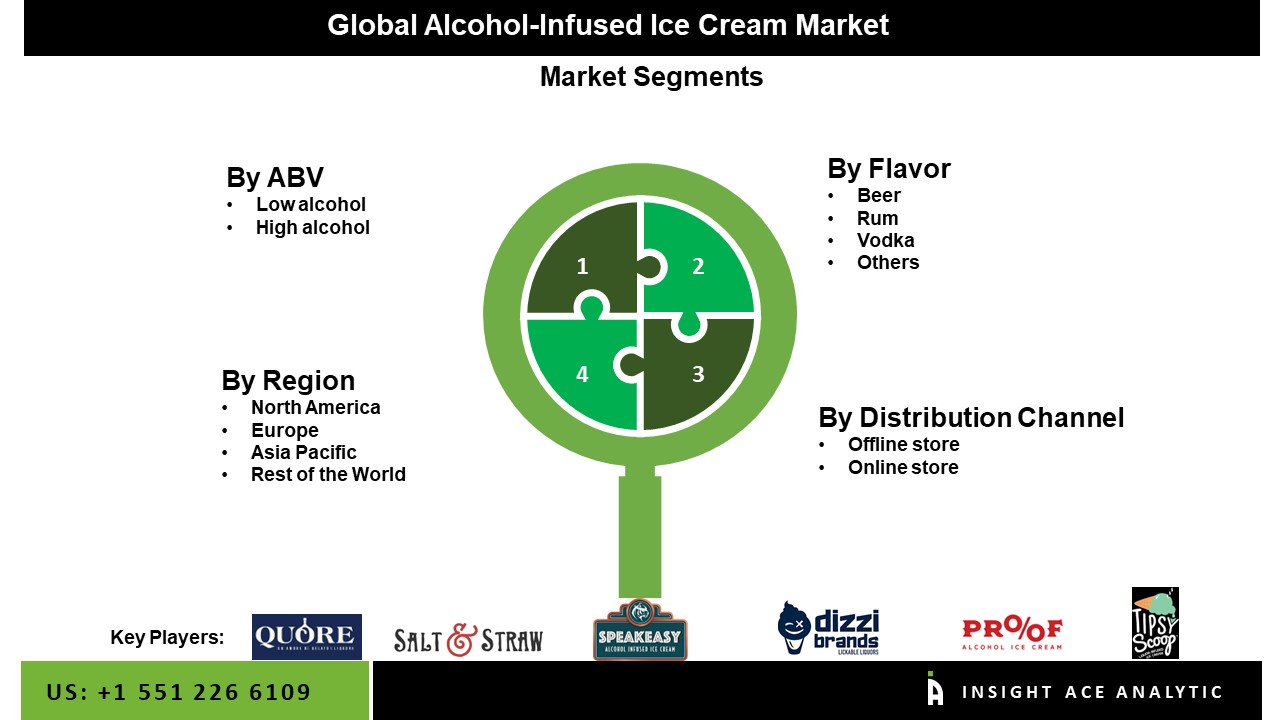
The alcohol-infused ice cream market is segmented based on ABV, distributional channel and flavor. Based on abv, the market is segmented as low alcohol and high alcohol. By distributional channel, the market is segmented into offline and online stores. By Flavor, the market is segmented into Beer, Rum, Vodka, and Others.
The low-alcohol category is expected to hold a significant share of the global alcohol-infused ice cream market in 2021. Since it may be served at birthdays and anniversaries, weddings, and other special events, low-alcohol ice cream has grown to be one of the most popular product categories for ice cream companies. Less than 0.75% of it is alcohol. Although it lacks the intoxicating properties of alcoholic beverages, it nonetheless imparts a flavor or aroma of the small dosages suitable for adults and children.
The beer segment is projected to grow rapidly in the global alcohol-infused ice cream market. This is because beer is produced, consumed, and traded globally and is well-liked by young people everywhere. Due to ongoing innovation in flavors, tastes, manufacturing, and other areas, the populace gravitates toward high-end, mild, and premium beverage items, including alcohol-infused ice cream. As a result, throughout the projection period, the factors mentioned above are anticipated to fuel the volume expansion of ice cream with added alcohol in the beer category., especially in countries such as the US, Germany, the UK, China, and India.
The alcohol-infused ice cream market in North America is anticipated to have the largest revenue share in the near future. This can be due to the region's huge focus on the environment, as well as the increased acceptance of alcohol-infused ice cream in several industries, including as food and beverage, personal care, packaging, automotive, and others.
In addition, the region's chemical sector is concentrating on the production of alcohol-infused ice cream in an effort to find ecologically beneficial and sustainable solutions. Increasing demand for bio-based components across sectors and widespread acceptance of alcohol-infused ice cream in the manufacturing of intermediate chemicals in the area are factors driving market expansion in the region.
Furthermore, Asia-Pacific is anticipated to develop at a high rate in the global market for alcohol-infused ice cream due to rising environmental concerns, rapid industrialization, government efforts, and increased financing for different sectors.
| Report Attribute | Specifications |
| Market size value in 2024 | USD 939.8 Million |
| Revenue forecast in 2034 | USD 2287.3 Million |
| Growth rate CAGR | CAGR of 9.5% from 2025 to 2034 |
| Quantitative units | Representation of revenue in US$ Mn, and CAGR from 2025 to 2034 |
| Historic Year | 2021 to 2024 |
| Forecast Year | 2025-2034 |
| Report coverage | The forecast of revenue, the position of the company, the competitive market structure, growth prospects, and trends |
| Segments covered | ABV, Distributional Channel and Flavor |
| Regional scope | North America; Europe; Asia Pacific; Latin America; Middle East & Africa |
| Country scope | U.S.; Canada; U.K.; Germany; China; India; Japan; Brazil; Mexico; The UK; France; Italy; Spain; China; Japan; India; South Korea; South East Asia; South Korea; South East Asia |
| Competitive Landscape | Buzz Bar, LLC. , Quore Gelato, Speakeasy Ice Creams Limited, Haagen-Dazs, SnoBar Cocktails, PROOF Alcohol Ice Cream, Hardscoop, Inc., Tipsy Scoop LLC., Arctic Buzz Ice Cream, POPd Ltd., Clementine's Naughty and Nice Creamery, Ben & Jerry's Homemade, Inc., Aubi & Ramsa 21 Ice Cream Co., DizziBrands, LLC, New Orleans Ice Cream Company, Mercer's Dairy, LiQ NV, Salt & Straw, LLC., Jeni's Splendid Ice Creams, LLC., Oddfellows Ice Cream Company |
| Customization scope | Free customization report with the procurement of the report, Modifications to the regional and segment scope. Particular Geographic competitive landscape. |
| Pricing and available payment methods | Explore pricing alternatives that are customized to your particular study requirements. |
By ABV
By Distribution channel
By Flavor
By Region-
North America-
Europe-
Asia-Pacific-
Latin America-
Middle East & Africa-
This study employed a multi-step, mixed-method research approach that integrates:
This approach ensures a balanced and validated understanding of both macro- and micro-level market factors influencing the market.
Secondary research for this study involved the collection, review, and analysis of publicly available and paid data sources to build the initial fact base, understand historical market behaviour, identify data gaps, and refine the hypotheses for primary research.
Secondary data for the market study was gathered from multiple credible sources, including:
These sources were used to compile historical data, market volumes/prices, industry trends, technological developments, and competitive insights.

Primary research was conducted to validate secondary data, understand real-time market dynamics, capture price points and adoption trends, and verify the assumptions used in the market modelling.
Primary interviews for this study involved:
Interviews were conducted via:
Primary insights were incorporated into demand modelling, pricing analysis, technology evaluation, and market share estimation.
All collected data were processed and normalized to ensure consistency and comparability across regions and time frames.
The data validation process included:
This ensured that the dataset used for modelling was clean, robust, and reliable.
The bottom-up approach involved aggregating segment-level data, such as:
This method was primarily used when detailed micro-level market data were available.

The top-down approach used macro-level indicators:
This approach was used for segments where granular data were limited or inconsistent.
To ensure accuracy, a triangulated hybrid model was used. This included:
This multi-angle validation yielded the final market size.
Market forecasts were developed using a combination of time-series modelling, adoption curve analysis, and driver-based forecasting tools.
Given inherent uncertainties, three scenarios were constructed:
Sensitivity testing was conducted on key variables, including pricing, demand elasticity, and regional adoption.