AI Native SMB Financial Operating System Market Size, Scope, Forecast Report 2026 to 2035
What is AI Native SMB Financial Operating System Market Size?
AI Native SMB Financial Operating System Market Size is valued at USD 4.30 Bn in 2025 and is predicted to reach USD 32.19 Bn by the year 2035 at a 22.5% CAGR during the forecast period for 2026 to 2035.
AI Native SMB Financial Operating System Market Size, Share & Trends Analysis By Module (Business Banking & Checking, Expense Management, Global Payments, Treasury Management, Stablecoin & Digital Assets), By Business Size (Micro Business, Small Business, Medium Business), and Segment Forecasts, 2026 to 2035
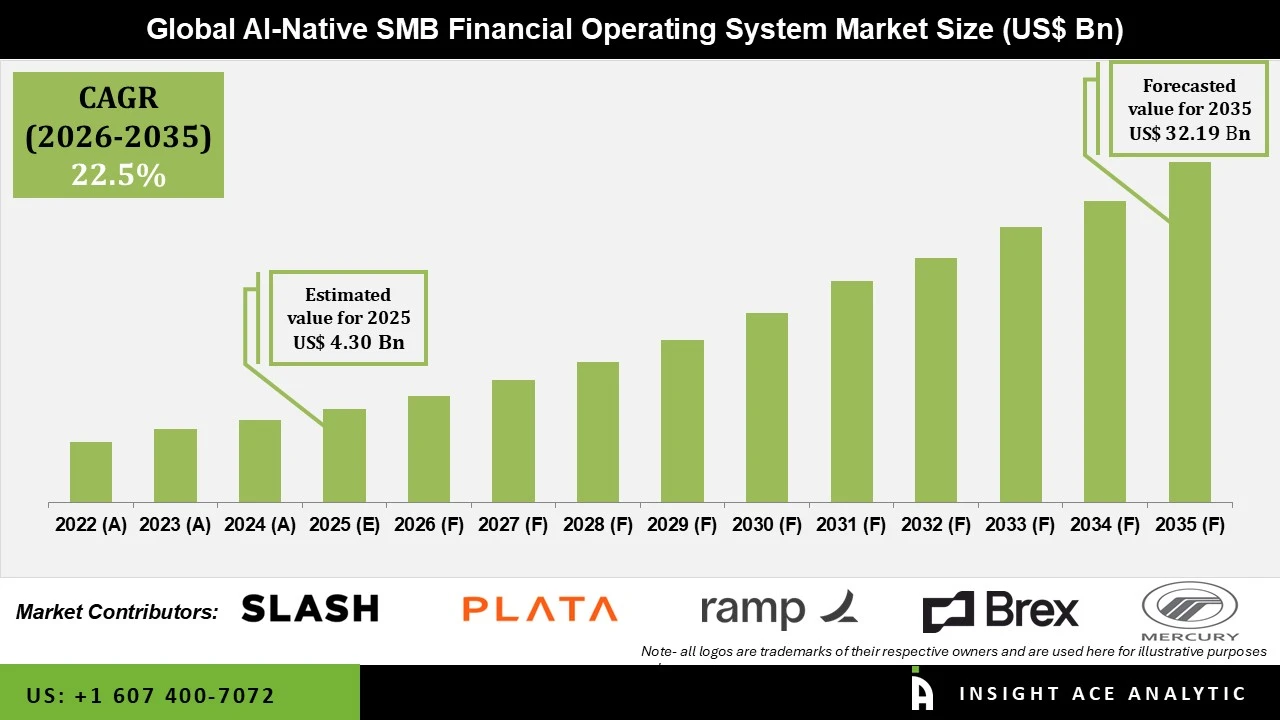
AI-based financial operating systems for SMBs are software applications that are built on the principles of artificial intelligence in order to facilitate and enhance the process of managing finances within small and medium-sized businesses. Such applications include accounting, invoicing, budget planning, expenses management, payroll services, accounts payable and receivable, cash flow forecasting, tax planning, and analysis. Machine learning, natural language processing, and predictive analytics enable such systems to cut down unnecessary workload and provide valuable insights to users.
The increased process of digital transformation among small companies, along with the growing need for automated management of finances, is one of the key factors behind market growth. Many small businesses struggle due to fragmented solutions, manual accounting, delays with reporting, and high costs of running a business. AI-based financial operating systems solve these problems by providing a single intelligent solution that constantly learns from transactions of its users.
The adoption of cloud computing has sped up the creation of financial systems for artificial intelligence. With the help of cloud computing, it becomes possible for SMBs to gain access to financial data securely from anywhere and get automatic software updates and scalability along with reduced infrastructure costs. The rise in the use of Software-as-a-Service (SaaS) model has made companies adopt operating systems based on AI with minimal IT expenses instead of the old accounting system.
In addition to this, due to the development of generative AI, the range of activities performed by such systems is not restricted to accounting only. The current AI systems perform automated invoicing, smart payment scheduling, fraud detection, financial advising, and conversation with financial assistants to answer queries related to the finances of the business.
Competitive Landscape
Which are the Leading Players in AI-Native SMB Financial Operating System Market?
• Intuit Inc.
• Xero Limited
• Sage Group plc
• Zoho Corporation
• FreshBooks
• BILL Holdings Inc.
• Brex Inc.
• Ramp Business Corporation
• Mercury Technologies Inc.
• QuickBooks
• Oracle NetSuite
• Odoo S.A.
• SAP SE
• Microsoft Corporation
• Stripe Inc.
• Airbase Inc.
• FloQast Inc.
• Puzzle Financial Inc.
• Rillet Inc.
• Vic.ai
• Docyt
• Dext
• Emburse
• Expensify
• Workday Inc.
• Fyle Technologies
• Wave Financial
• Bench Accounting
• Pilot.com
• Mesh Payments
Market Dynamics
Driver
Increasing Demand for Financial Automation Among SMBs
Automation of financial operations has become one of the key needs of small and mid-sized companies that wish to increase their efficiency and decrease workload. Traditional systems of accounting are based on manual input of data, matching of invoices, classification of expenses, bank reconciliation, and compliance reports. Automated systems of financial operations use intelligent algorithms to carry out such actions automatically, helping to decrease number of mistakes and increase effectiveness. Shortage of professionals in the sphere of accounting has increased the necessity of automation even more. Many companies are unable to hire finance staff because of lack of necessary finances and use automated systems for bookkeeping, financial reports, forecasting of cash flows, and control of company's activities in real-time mode.
Moreover, growth of transaction volume and its complexity means that many companies have much bigger volumes of financial data to work with. Intelligent systems allow automatic classification of transactions, fraud control, and forecasting of financial activities of businesses. Rapid development of SaaS solutions for financial management, along with growing popularity of AI-driven business intelligence, will be one of the major factors influencing the development of market of AI-Native SMB Financial Operating System during next decade.
Restrain/Challenge
Data Privacy Concerns and Integration Complexity
However, while the market holds significant promise, issues related to financial data privacy and cybersecurity continue to hinder growth of the market. AI native financial platforms deal with highly sensitive data such as payroll information, banking transactions, tax returns, customer invoices, and payment records. Any data leak or security issue can lead to losses in addition to compliance penalties. Many SMEs have several legacy software applications in place for accounting, payroll processing, banking operations, inventory management, and CRM. The integration of such disconnected platforms into one AI-based financial operating system is technologically difficult and can take considerable time to implement due to poor data quality, inconsistent financial data, and incompatible software architecture.
Additionally, companies operating in different nations need to adhere to various financial reporting, tax regulations, and data protection laws. Constant updates of AI models to meet compliance requirements increase cost of development for vendors. Lack of knowledge of AI among smaller companies and worries about the precision of automated financial recommendations also continue to hinder adoption, especially in emerging markets.
Small Businesses Segment is Expected to Hold the Largest Share in the AI-Native SMB Financial Operating System Market
Small businesses formed the segment with the highest market share in 2025 and would continue to dominate during the forecast period. Small businesses find the need to have cost-efficient financial management tools in order to cut reliance on third-party accountants and make operations efficient. AI-native financial operating system includes bookkeeping, invoices creation, expense reporting, payroll, tax calculations, cash flow management and forecasting, all from one cloud platform. Increasingly, many small businesses embrace digital payments, online banking, and e-commerce platforms, which leads to a rise in financial transactions. Financial transactions are managed more easily with the help of AI-powered financial operating system, since such system can categorize transactions, reconcile the accounts, identify anomalies and create financial reports instantly. Subscription-based pricing models have contributed towards making the technology available even for companies with tight IT budget.
Cloud-based Deployment Segment is Growing at the Highest Rate in the AI-Native SMB Financial Operating System Market
It is projected that the cloud-based deployment segment will register the highest growth rate during the forecast period. Cloud financial operating systems do not require costly physical infrastructure and offer secure and scalable financial management capabilities to organizations. Financial management information can be accessed by users from anywhere through cloud-based solutions via desktop and mobile devices. Software maintenance is simplified through automatic updates, data backup, disaster recovery, and improved security in cloud deployments.
Moreover, artificial intelligence algorithms deployed in cloud computing environments make continuous analysis of financial transactions to produce predictive analysis, automate accounting processes, optimize working capital management, and enable strategic decision-making. Integration with digital banking platforms, payment gateways, ERP software, CRM applications, and tax portals further drives the usage of cloud financial operating systems in the SMB market. High-speed internet availability, rising cloud adoption among SMEs, and the development of the SaaS ecosystem further fuel the growth of this segment.
Why North America Led the AI-Native SMB Financial Operating System Market?
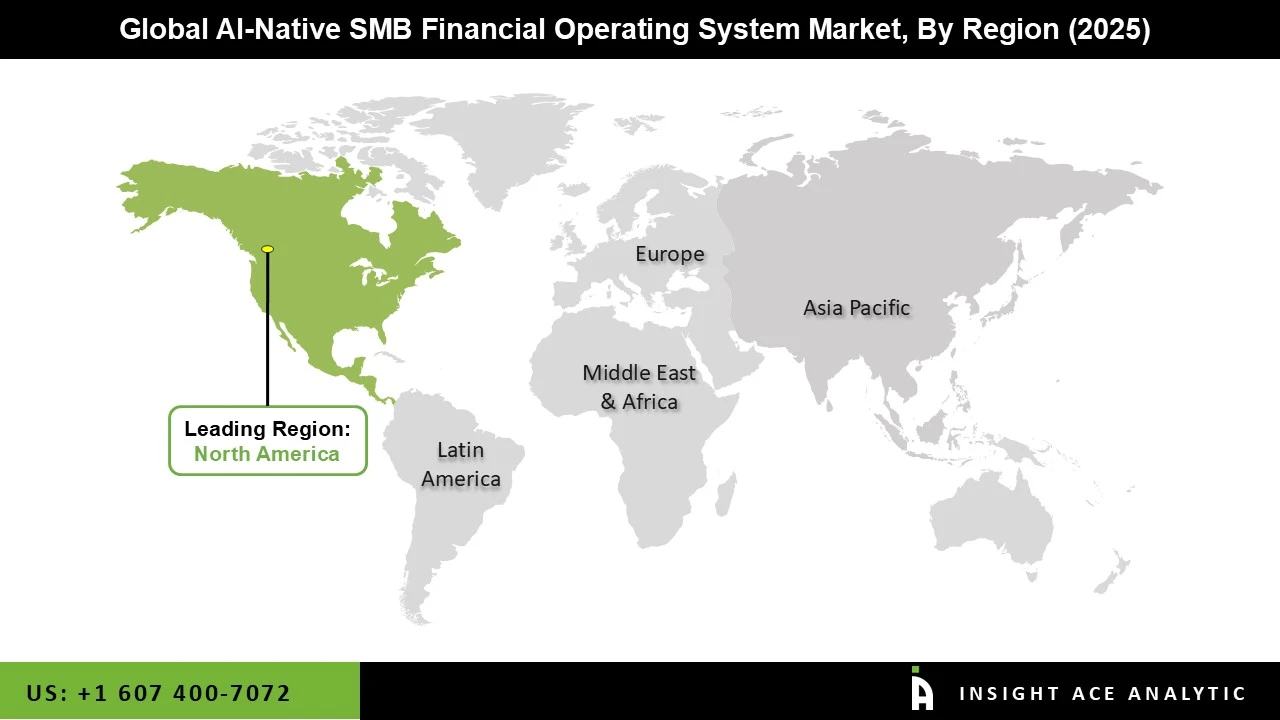
In 2025, North America held the dominant position within the AI-Native SMB Financial Operating System Market owing to its mature digital economy, cloud computing technology, and a robust presence of major fintech companies and enterprise software providers. One of the highest levels of adoption of AI-based accounting and financial automation software for SMBs can be observed in the United States.
Many businesses in the region utilize AI-native financial systems to automate bookkeeping, tax filing, invoice processing, payroll management, financial reports, and business forecasts. The high level of digital payments and embedded finance adoption has positively impacted the adoption of the market.
North America has advanced cloud infrastructure and investment in artificial intelligence technologies along with a developed ecosystem of startups that develop next-gen financial software. Regulations promoting e-invoicing, cybersecurity, and digital tax filing have also positively impacted market adoption.
Key Development
• In October 2025, BILL Holdings launched new AI agents intended to support more automated accounts-payable workflows. According to the company, its AI capabilities had increased the number of fully automated bills and were being applied across document processing, fraud prevention, and payment operations.
AI-Native SMB Financial Operating System Market Report Scope:
| Report Attribute | Specifications |
| Market size value in 2025 | USD 4.30 Bn |
| Revenue forecast in 2035 | USD 32.19 Bn |
| Growth Rate CAGR | CAGR of 22.5% from 2026 to 2035 |
| Quantitative Units | Representation of revenue in US$ Bn and CAGR from 2026 to 2035 |
| Historic Year | 2022 to 2025 |
| Forecast Year | 2026-2035 |
| Report Coverage | The forecast of revenue, the position of the company, the competitive market structure, growth prospects, and trends |
| Segments Covered | Module, Business Size and By Region |
| Regional Scope | North America; Europe; Asia Pacific; Latin America; Middle East & Africa |
| Country Scope | U.S.; Canada; U.K.; Germany; China; India; Japan; Brazil; Mexico; The UK; France; Italy; Spain; China; Japan; India; South Korea; Southeast Asia; South Korea; Southeast Asia |
| Competitive Landscape | Intuit Inc., Xero Limited, Sage Group plc, Zoho Corporation, FreshBooks, BILL Holdings Inc., Brex Inc., Ramp Business Corporation, Mercury Technologies, Oracle NetSuite, Microsoft Corporation, SAP SE, Odoo S.A., Stripe Inc., Airbase Inc., FloQast, Puzzle Financial, Rillet, Vic.ai, Docyt, Dext, Emburse, Expensify, Workday Inc., Fyle Technologies, Wave Financial, Bench Accounting, Pilot.com, Mesh Payments. |
| Customization Scope | Free customization report with the procurement of the report, Modifications to the regional and segment scope. Geographic competitive landscape. |
| Pricing and Available Payment Methods | Explore pricing alternatives that are customized to your particular study requirements. |
Market Segmentation:
AI-Native SMB Financial Operating System Market by Module -
• Business Banking & Checking
• Expense Management
• Global Payments
• Treasury Management
• Stablecoin & Digital Assets
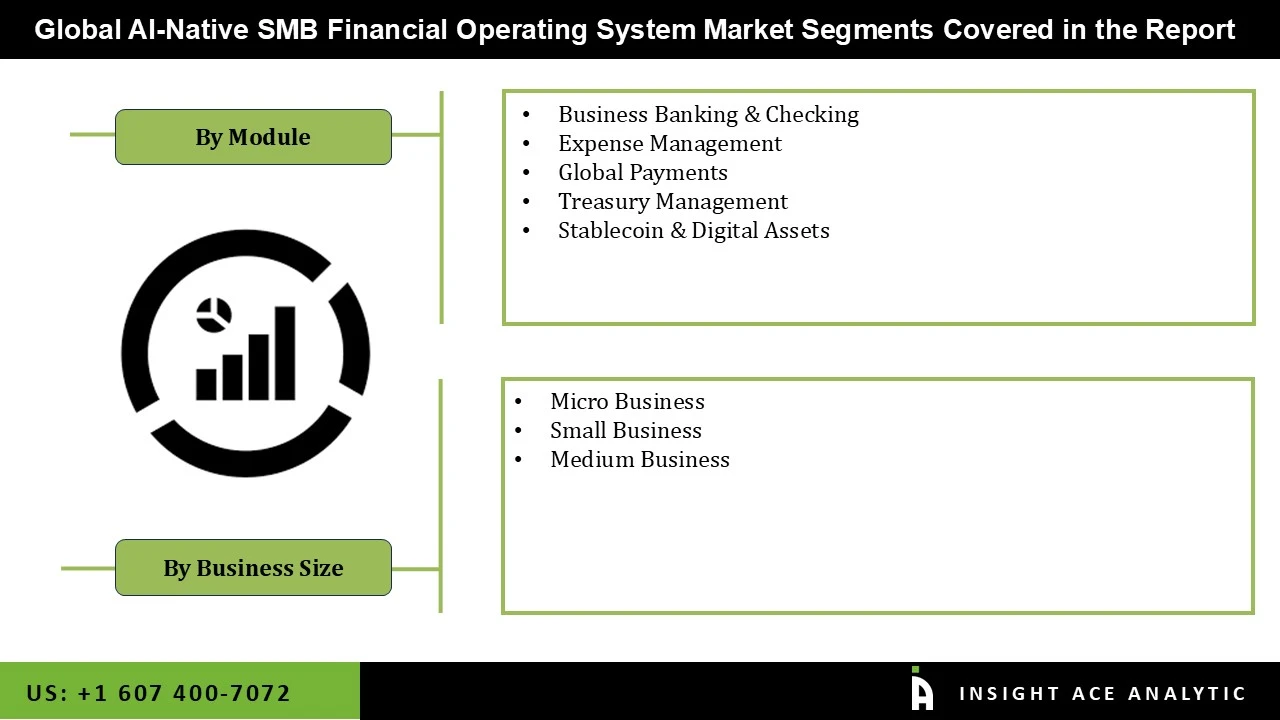
AI-Native SMB Financial Operating System Market by Business Size -
• Micro Business
• Small Business
• Medium Business
AI-Native SMB Financial Operating System Market By Region-
North America-
• The US
• Canada
Europe-
• Germany
• The UK
• France
• Italy
• Spain
• Rest of Europe
Asia-Pacific-
• China
• Japan
• India
• South Korea
• South East Asia
• Rest of Asia Pacific
Latin America-
• Brazil
• Argentina
• Mexico
• Rest of Latin America
Middle East & Africa-
• GCC Countries
• South Africa
• Rest of Middle East and Africa
Research Design and Approach
This study employed a multi-step, mixed-method research approach that integrates:
- Secondary research
- Primary research
- Data triangulation
- Hybrid top-down and bottom-up modelling
- Forecasting and scenario analysis
This approach ensures a balanced and validated understanding of both macro- and micro-level market factors influencing the market.
Secondary Research
Secondary research for this study involved the collection, review, and analysis of publicly available and paid data sources to build the initial fact base, understand historical market behaviour, identify data gaps, and refine the hypotheses for primary research.
Sources Consulted
Secondary data for the market study was gathered from multiple credible sources, including:
- Government databases, regulatory bodies, and public institutions
- International organizations (WHO, OECD, IMF, World Bank, etc.)
- Commercial and paid databases
- Industry associations, trade publications, and technical journals
- Company annual reports, investor presentations, press releases, and SEC filings
- Academic research papers, patents, and scientific literature
- Previous market research publications and syndicated reports
These sources were used to compile historical data, market volumes/prices, industry trends, technological developments, and competitive insights.

Primary Research
Primary research was conducted to validate secondary data, understand real-time market dynamics, capture price points and adoption trends, and verify the assumptions used in the market modelling.
Stakeholders Interviewed
Primary interviews for this study involved:
- Manufacturers and suppliers in the market value chain
- Distributors, channel partners, and integrators
- End-users / customers (e.g., hospitals, labs, enterprises, consumers, etc., depending on the market)
- Industry experts, technology specialists, consultants, and regulatory professionals
- Senior executives (CEOs, CTOs, VPs, Directors) and product managers
Interview Process
Interviews were conducted via:
- Structured and semi-structured questionnaires
- Telephonic and video interactions
- Email correspondences
- Expert consultation sessions
Primary insights were incorporated into demand modelling, pricing analysis, technology evaluation, and market share estimation.
Data Processing, Normalization, and Validation
All collected data were processed and normalized to ensure consistency and comparability across regions and time frames.
The data validation process included:
- Standardization of units (currency conversions, volume units, inflation adjustments)
- Cross-verification of data points across multiple secondary sources
- Normalization of inconsistent datasets
- Identification and resolution of data gaps
- Outlier detection and removal through algorithmic and manual checks
- Plausibility and coherence checks across segments and geographies
This ensured that the dataset used for modelling was clean, robust, and reliable.
Market Size Estimation and Data Triangulation
Bottom-Up Approach
The bottom-up approach involved aggregating segment-level data, such as:
- Company revenues
- Product-level sales
- Installed base/usage volumes
- Adoption and penetration rates
- Pricing analysis
This method was primarily used when detailed micro-level market data were available.

Top-Down Approach
The top-down approach used macro-level indicators:
- Parent market benchmarks
- Global/regional industry trends
- Economic indicators (GDP, demographics, spending patterns)
- Penetration and usage ratios
This approach was used for segments where granular data were limited or inconsistent.
Hybrid Triangulation Approach
To ensure accuracy, a triangulated hybrid model was used. This included:
- Reconciling top-down and bottom-up estimates
- Cross-checking revenues, volumes, and pricing assumptions
- Incorporating expert insights to validate segment splits and adoption rates
This multi-angle validation yielded the final market size.
Forecasting Framework and Scenario Modelling
Market forecasts were developed using a combination of time-series modelling, adoption curve analysis, and driver-based forecasting tools.
Forecasting Methods
- Time-series modelling
- S-curve and diffusion models (for emerging technologies)
- Driver-based forecasting (GDP, disposable income, adoption rates, regulatory changes)
- Price elasticity models
- Market maturity and lifecycle-based projections
Scenario Analysis
Given inherent uncertainties, three scenarios were constructed:
- Base-Case Scenario: Expected trajectory under current conditions
- Optimistic Scenario: High adoption, favourable regulation, strong economic tailwinds
- Conservative Scenario: Slow adoption, regulatory delays, economic constraints
Sensitivity testing was conducted on key variables, including pricing, demand elasticity, and regional adoption.
Request Customization
Add countries, segments, company profiles, or extend forecast — free 10% customization with purchase.
Customize This Report →Enquire Before Buying
Speak with our analyst team about scope, methodology, pricing, or deliverable formats.
Enquire Now →Frequently Asked Questions
AI Native SMB Financial Operating System Market Size is valued at USD 4.30 Bn in 2025 and is predicted to reach USD 32.19 Bn by the year 2035
AI Native SMB Financial Operating System Market is expected to grow at a 22.5% CAGR during the forecast period for 2026 to 2035.
Intuit Inc., Xero Limited, Sage Group plc, Zoho Corporation, FreshBooks, BILL Holdings Inc., Brex Inc., Ramp Business Corporation, Mercury Technologies, Oracle NetSuite, Microsoft Corporation, SAP SE, Odoo S.A., Stripe Inc., Airbase Inc., FloQast, Puzzle Financial, Rillet, Vic.ai, Docyt, Dext, Emburse, Expensify, Workday Inc., Fyle Technologies, Wave Financial, Bench Accounting, Pilot.com, Mesh Payments.
AI Native SMB Financial Operating System Market is segmented into Module, Business Size and By Region
North America region is leading the AI Native SMB Financial Operating System Market.