



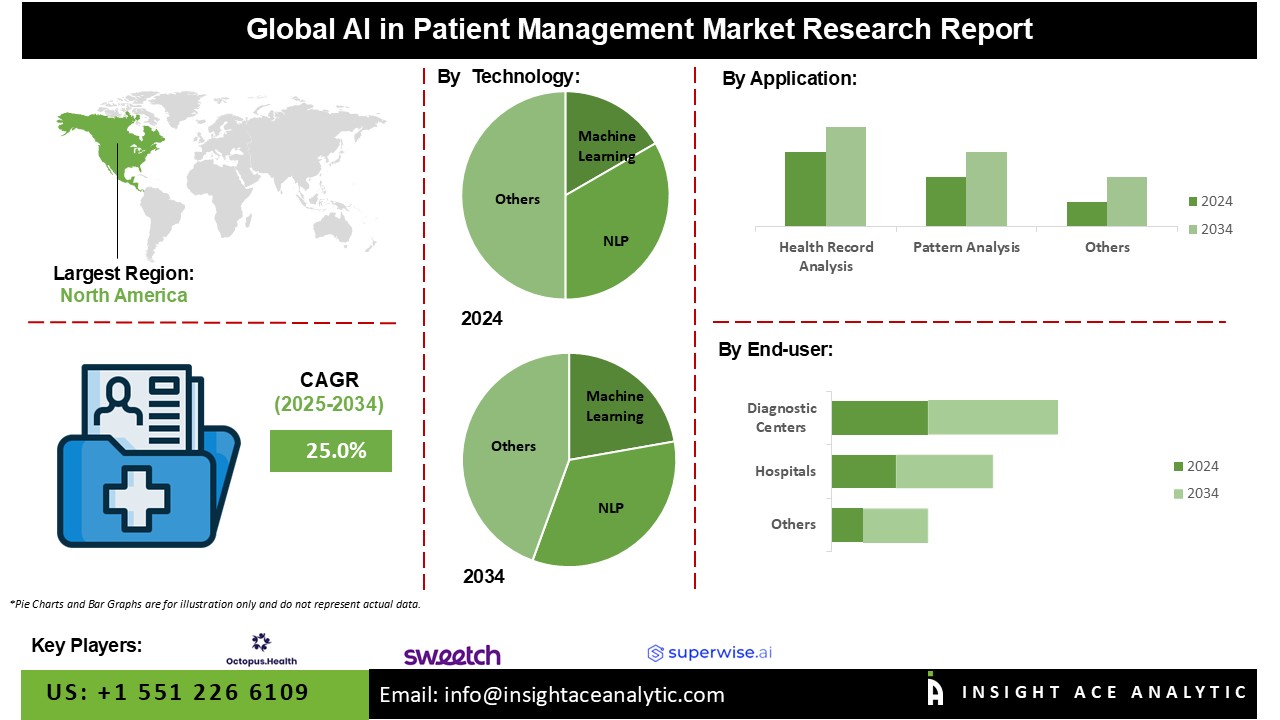
AI in Patient Management Market Size is predicted to witness a 25.0% CAGR during the forecast period for 2025-2034.
The field of AI in patient management is undergoing significant development, with the potential to enhance care quality, decrease expenses, and improve the overall patient experience. This is achieved through the utilisation of data-driven insights and automation, which aid healthcare personnel in their decision-making processes and interactions with patients.
Artificial intelligence is employed in all patient management software, which medical institutions use to facilitate diagnosis, treatment, and monitoring. The market's growth is primarily pushed by increased healthcare data and the complexities of datasets, which drives the need for AI in patient management software in the industry.
Furthermore, advances in processing power and lower hardware prices, increased cross-industry partnerships and collaborations, and increased imbalance between the health personnel and patients fuel the need for improved healthcare services. Due to a shortage of competent healthcare personnel, there is an increase in demand for AI algorithms that can be used in the healthcare sector.
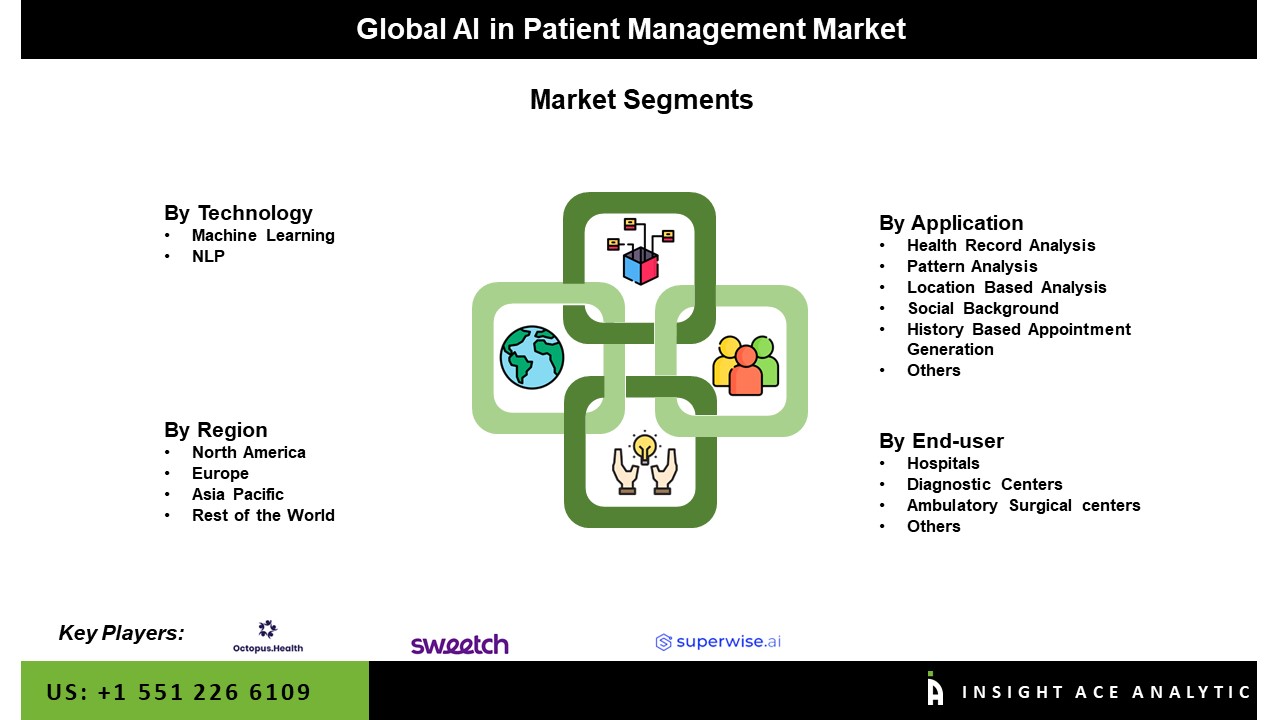
The AI in Patient Management market has been segmented based on technology, application, and end-user. The market is divided into machine learning and NLP based on technology. The application segment includes health record analysis, pattern analysis, location-basedlocation-based analysis, social background, history-basedand history-based appointment generation. The end-users segment includes hospitals, diagnostic centres, ambulatory surgical centres, and others.
Machine learning has advanced rapidly due to AI systems' increased processing capabilities. AI algorithm innovation is also expected to reduce processing times, enhancing the application of algorithms in the healthcare industry. For example, in June 2020, GE Healthcare launched Thoracic Care Suite to detect chest X-ray abnormalities caused by COVID-19, such as pneumonia and tuberculosis, as well as to assist physicians and health systems in ensuring timely diagnosis and appropriate patient treatment.
Healthcare systems may become smarter, faster, and more efficient in providing treatment to millions of people worldwide by integrating artificial intelligence in hospital settings and clinics. Artificial intelligence in healthcare is truly the future, altering how patients receive excellent treatment while lowering provider costs and improving health outcomes.
North America was the largest shareholder in artificial intelligence in the healthcare market, owing to its well-established healthcare infrastructure and support of government laws for product-type commercialization, which are the primary reasons driving the growth of AI in the healthcare industry.
However, Asia-Pacific is anticipated to expand at the fastest rate during the forecast period, owing to increased adoption of healthcare IT solutions, increased funding for the development of AI capabilities, and major players collaborating with universities and research centres to build advanced AI algorithms that could be used in the healthcare industry.
AI in Patient Management Market Report Scope
| Report Attribute | Specifications |
| Growth Rate CAGR | CAGR of 25.0% from 2025 to 2034 |
| Quantitative Units | Representation of revenue in US$ Bn and CAGR from 2025 to 2034 |
| Historic Year | 2021 to 2024 |
| Forecast Year | 2025-2034 |
| Report Coverage | The forecast of revenue, the position of the company, the competitive market structure, growth prospects, and trends |
| Segments Covered | By Technology, Application, End-Use |
| Regional Scope | North America; Europe; Asia Pacific; Latin America; Middle East & Africa |
| Country Scope | U.S.; Canada; U.K.; Germany; China; India; Japan; Brazil; Mexico ;The UK; France; Italy; Spain; South Korea; South East Asia |
| Competitive Landscape | Welltok, Inc. (Virgin Pulse), Intel Corporation, Nvidia Corporation, Google Inc., IBM Corporation, Microsoft Corporation, General Vision, Inc., Enlitic, Inc., Next IT Corporation, and iCarbonX. Octopus.Health, Sweetch Health Ltd., Superwise.ai And others. |
| Customization Scope | Free customization report with the procurement of the report, Modifications to the regional and segment scope. Particular Geographic competitive landscape. |
| Pricing And Available Payment Methods | Explore pricing alternatives that are customized to your particular study requirements. |
AI in Patient Management Market By Technology-
AI in Patient Management Market By Application-
AI in Patient Management Market By End-Users-
AI in Patient Management Market By Region-
North America-
Europe-
Asia-Pacific-
Latin America-
Middle East & Africa-
This study employed a multi-step, mixed-method research approach that integrates:
This approach ensures a balanced and validated understanding of both macro- and micro-level market factors influencing the market.
Secondary research for this study involved the collection, review, and analysis of publicly available and paid data sources to build the initial fact base, understand historical market behaviour, identify data gaps, and refine the hypotheses for primary research.
Secondary data for the market study was gathered from multiple credible sources, including:
These sources were used to compile historical data, market volumes/prices, industry trends, technological developments, and competitive insights.

Primary research was conducted to validate secondary data, understand real-time market dynamics, capture price points and adoption trends, and verify the assumptions used in the market modelling.
Primary interviews for this study involved:
Interviews were conducted via:
Primary insights were incorporated into demand modelling, pricing analysis, technology evaluation, and market share estimation.
All collected data were processed and normalized to ensure consistency and comparability across regions and time frames.
The data validation process included:
This ensured that the dataset used for modelling was clean, robust, and reliable.
The bottom-up approach involved aggregating segment-level data, such as:
This method was primarily used when detailed micro-level market data were available.

The top-down approach used macro-level indicators:
This approach was used for segments where granular data were limited or inconsistent.
To ensure accuracy, a triangulated hybrid model was used. This included:
This multi-angle validation yielded the final market size.
Market forecasts were developed using a combination of time-series modelling, adoption curve analysis, and driver-based forecasting tools.
Given inherent uncertainties, three scenarios were constructed:
Sensitivity testing was conducted on key variables, including pricing, demand elasticity, and regional adoption.