



Global AI-Enabled X-Ray Imaging Solutions Market Size is valued at USD 184.5 Million in 2024 and is predicted to reach USD 978.9 Million by the year 2034 at a 18.3% CAGR during the forecast period for 2025-2034.
Key Industry Insights & Findings from the Report:

X-Ray Imaging Solutions have been a crucial part of the healthcare industry across the world over the past decades and they are expected to be crucial aspects over the coming years as well. The increasing digitization of the healthcare industry and rising technological advancements are expected to be prominent factors driving the adoption of AI-Enabled X-Ray Imaging Solutions on a global scale. Increasing demand for technologically advanced products and the rising popularity of AI in the global landscape will also act in favor of AI-Enabled X-Ray Imaging Solutions market growth through 2031.
Increasing demand for better imaging solutions by patients and healthcare professionals is expected to prominently drive AI-Enabled X-Ray Imaging Solutions market growth over the forecast period. The increasing prevalence of chronic diseases, rising geriatric population, and increasing investments in research and development of imaging systems will also propel AI-Enabled X-Ray Imaging Solutions market growth through 2031.
However, the high costs of AI-Enabled X-Ray Imaging Solutions and the lack of skilled professionals to operate the same will have a hindering effect on the global growth potential across the forecast period. Increasing demand for radiology diagnostics will also aid market growth.
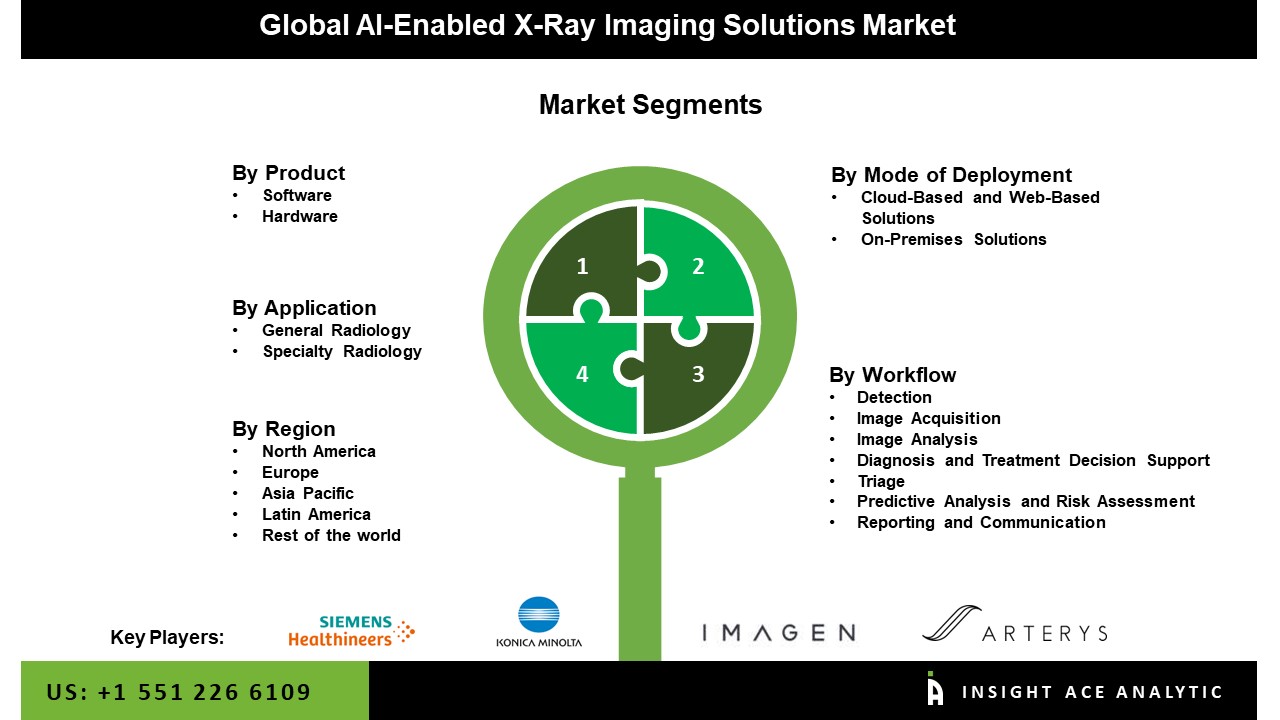
The AI-Enabled X-Ray Imaging Solutions market is segmented on the basis of products, mode of deployment, workflow and application. On the basis of products, the market is segmented as software and hardware. Based on mode of deployment, the market is segmented into Cloud-Based and Web-Based Solutions and On-Premises Solutions. By application, the market is segmented into General Radiology and Specialty Radiology. By workflow, the market is segmented into Detection, Image Acquisition, Image Analysis, Diagnosis and Treatment Decision Support, Triage, Predictive Analysis and Risk Assessment, Reporting and Communication.
It is projected that the hardware segment would dominate the market in terms of both revenue and volume share. Increasing demand for new hardware components for advanced AI systems will drive growth in this segment. On the other hand, growing advancements in software technologies will create lucrative opportunities for the software segment over the forecast period.
AI-Enabled X-Ray Imaging Solutions are mainly deployed for diagnostic procedures and are primarily used for the same across the world. This creates a major scope of growth for the detection segment as it is the crucial step in diagnosis and treatment procedures and is the initial step to determine the cause and nature of the ailment. Image acquisition and image analysis services are expected to see high demand as the complexity of these new AI enable images increases with increasing parameters to analyze.
North America accounted for a major market share in the global AI-Enabled X-Ray Imaging Solutions market landscape and is projected to uphold this stance over the forecast period as well. The presence of developed healthcare infrastructure, rapid adoption of advanced technologies, increasing demand for radiology diagnostics procedures, and high healthcare spending potential are anticipated to be significant factors governing the AI-Enabled X-Ray Imaging Solutions market potential in this region over the forecast period. The rising prevalence of cancer and the high availability of AI-Enabled X-Ray Imaging Solutions are other factors that guide AI-Enabled X-Ray Imaging Solution market growth through 2030 in the United States, which is expected to be the major market in this region in the coming years.
| Report Attribute | Specifications |
| Market Size Value In 2024 | USD 184.5 Million |
| Revenue Forecast In 2034 | USD 978.9 Million |
| Growth Rate CAGR | CAGR of 18.3% from 2025 to 2034 |
| Quantitative Units | Representation of revenue in US$ Mn and CAGR from 2025 to 2034 |
| Historic Year | 2021 to 2024 |
| Forecast Year | 2025-2034 |
| Report Coverage | The forecast of revenue, the position of the company, the competitive market structure, growth prospects, and trends |
| Segments Covered | By Mode of Deployment, By Application, By Workflow |
| Regional Scope | North America; Europe; Asia Pacific; Latin America; Middle East & Africa |
| Country Scope | U.S.; Canada; U.K.; Germany; China; India; Japan; Brazil; Mexico ;The UK; France; Italy; Spain; China; Japan; India; South Korea; South East Asia; South Korea; South East Asia |
| Competitive Landscape | Agfa-Gevaert NV, Arterys, Inc, Behold.AI Technologies Limited, Carestream Health, Inc, Enlitic, Inc, General Electric Company, Imagen Technologies, Inc., Infervision Medical Technology Co. Ltd., Konica Minolta, Inc., Lunit, Inc., Quibim, S.L., Qure.ai Technologies Pvt. Ltd., Siemens Healthineers AG, Vuno Co., Ltd., Zebra Medical Vision, Inc., Other Prominent Players. |
| Customization Scope | Free customization report with the procurement of the report, Modifications to the regional and segment scope. Particular Geographic competitive landscape. |
| Pricing And Available Payment Methods | Explore pricing alternatives that are customized to your particular study requirements. |
By Product-
By Mode of Deplopyment
By Application
By Workflow
By Region-
North America-
Europe-
Asia-Pacific-
Latin America-
Middle East & Africa-
This study employed a multi-step, mixed-method research approach that integrates:
This approach ensures a balanced and validated understanding of both macro- and micro-level market factors influencing the market.
Secondary research for this study involved the collection, review, and analysis of publicly available and paid data sources to build the initial fact base, understand historical market behaviour, identify data gaps, and refine the hypotheses for primary research.
Secondary data for the market study was gathered from multiple credible sources, including:
These sources were used to compile historical data, market volumes/prices, industry trends, technological developments, and competitive insights.

Primary research was conducted to validate secondary data, understand real-time market dynamics, capture price points and adoption trends, and verify the assumptions used in the market modelling.
Primary interviews for this study involved:
Interviews were conducted via:
Primary insights were incorporated into demand modelling, pricing analysis, technology evaluation, and market share estimation.
All collected data were processed and normalized to ensure consistency and comparability across regions and time frames.
The data validation process included:
This ensured that the dataset used for modelling was clean, robust, and reliable.
The bottom-up approach involved aggregating segment-level data, such as:
This method was primarily used when detailed micro-level market data were available.

The top-down approach used macro-level indicators:
This approach was used for segments where granular data were limited or inconsistent.
To ensure accuracy, a triangulated hybrid model was used. This included:
This multi-angle validation yielded the final market size.
Market forecasts were developed using a combination of time-series modelling, adoption curve analysis, and driver-based forecasting tools.
Given inherent uncertainties, three scenarios were constructed:
Sensitivity testing was conducted on key variables, including pricing, demand elasticity, and regional adoption.