Protein Expression Market Size, Trend, Forecast Report 2026 to 2035
What is Protein Expression Market Size?
Global Protein Expression Market Size is valued at USD 3.05 Bn in 2025 and is predicted to reach USD 7.03 Bn by the year 2035 at an 9.0% CAGR during the forecast period for 2026 to 2035.
Protein Expression Market, Share & Trends Analysis Report, By Type of Protein Expression System (Algal, Cell-free, Insect, Mammalian, Prokaryotic and Yeast), Protein Expression-related Offerings (Competent Cells, Expression Vectors, Instruments, Kits and Reagents, and Protein Expression Services), Application Aera, End-Users, Type of Operation, By Region and Segment Forecasts, 2026 to 2035.
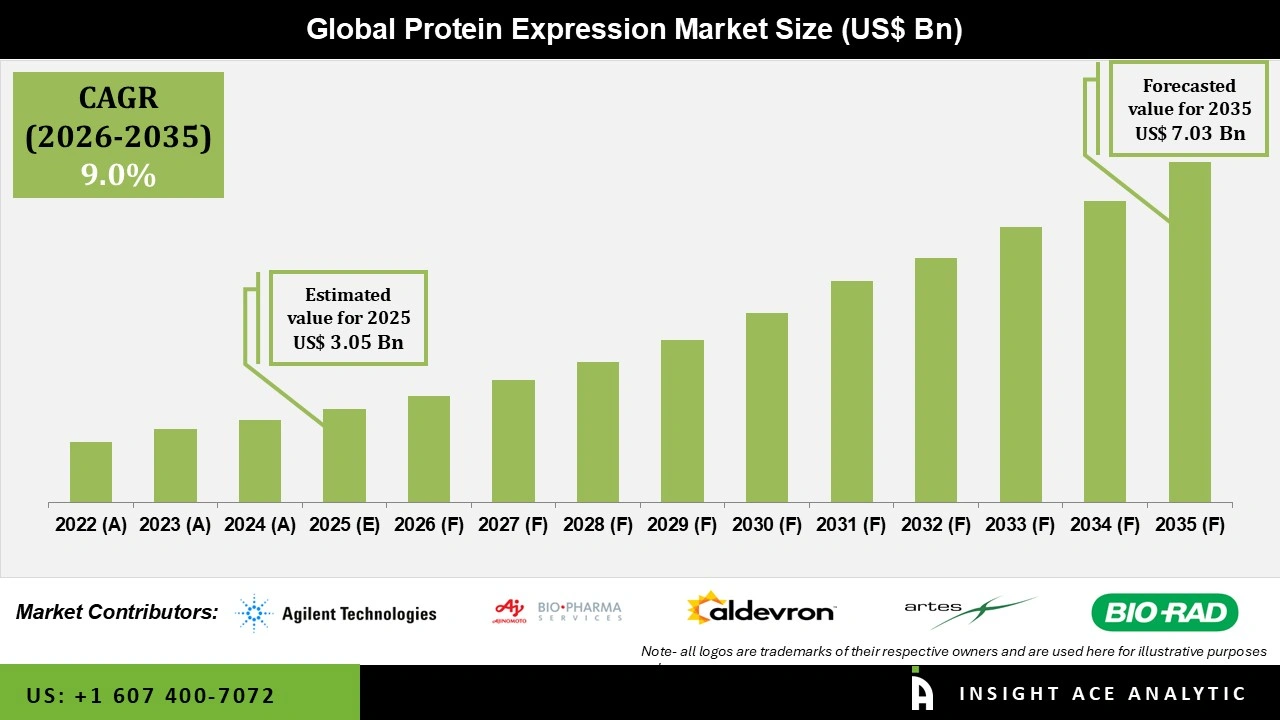
Protein Expression Market Key Takeaways:
|
The technique of creating an artificial protein, known as a heterologous protein, involves introducing recombinant DNA into a host cell, a process that exemplifies the essential biological function of protein expression. This fundamental process is so critical that even the simplest prokaryotic organisms dedicate nearly 80% of their energy and over half of their dry weight to it. Cells, as the basic building blocks of life, must synthesize proteins using the instructions encoded in their DNA, as these proteins determine their unique shapes and structures. According to the fundamental dogma of molecular biology, genetic information flows from DNA to RNA through transcription and is then translated into proteins, highlighting the intricate connection between genetics and cellular function.
In June 2024, the Broad Institute unveiled a groundbreaking epigenetic editing method capable of permanently silencing the gene responsible for producing prion proteins in the brain using molecular tools. This innovative approach, which involves a single intravenous injection of a modified adeno-associated virus (AAV), has shown promising results in animal studies, reducing prion protein levels by over 80%, and potentially paving the way for new treatments for prion diseases. In a related development, the FDA approved fifty new medications in 2021, including fourteen biologics—such as monoclonal antibodies, pegylated proteins, hormones, and enzymes—all of which require protein expression. Notably, the approval of upheld, a co-packaged preventive treatment, and various monoclonal antibodies like tocilizumab and sotrovimab for COVID-19 further highlighted the importance of protein biologics. As the FDA was expected to approve several additional medications in 2022, the growing demand for these products has significantly increased the need for protein expression goods and services, driving market expansion.
Competitive Landscape
Some of the Major Key Players in the Protein Expression Market are
- Agilent Technologies
- Ajinomoto Bio-Pharma Services
- Aldevron
- Artes Biotechnology Gmbh
- Bio-Rad Laboratories
- Bioneer Corporation
- Cayman Chemical
- Charles River Laboratories
- Corning Incorporated
- Domainex
- Danaher Corporation
- Eurofins Calixar
- Fujifilm Irvine Scientific, Inc.
- Genext Genomics
- Genscript Biotech
- Lonza
- Lucigen Corporation
- Lifesensors Inc
- Leading Biology, Inc.
- Merck Kgaa
- New England Biolabs
- Oxford Expression Technologies
- Promab
- Promega
- Proteogenix
- Peak Proteins Ltd
- Qiagen
- Sartorius
- Synbio Technologies
- Syngene
- Synthetic Genomics Inc
- Sino Biological Inc
- Jena Bioscience
- Takara Bio
- Thermo Fisher Scientific
- Wuxi Biologics
Market Segmentation
The Protein Expression Market is segmented based on the type of protein expression system, protein expression-related offerings, application area, end-users, and type of operation. Based on the type of protein expression system, the market is divided into algal, cell-free, insect, mammalian, prokaryotic, and yeast. Based on the Protein Expression-related Offerings, the market is divided into competent cells, expression vectors, instruments, kits and reagents, and protein expression services. The market is categorized into academic and research institutes, CROS and CDMOS, pharmaceutical/biotechnology companies, and other end-users based on the end user. Based on the application area, the market is categorized into research and diagnostics, and therapeutics. Based on the type of operation, the market is categorized into In-house and outsourced operations.
The Prokaryotic Expression Systems Segment is Expected to Have the Highest Growth Rate During the Forecast Period
Based on the type of protein expression system, the market is divided into algal, cell-free, insect, mammalian, prokaryotic, and yeast. Among these, prokaryotic expression systems (particularly Escherichia coli) typically drive and hold the largest share of the protein expression market. his is due to their simplicity, cost-effectiveness, high yield, and rapid production rates. Prokaryotic systems are widely used in research and industrial applications to produce recombinant proteins. However, as the demand for more complex proteins grows, other systems like mammalian and yeast expression systems are also gaining significance for their ability to produce proteins with proper post-translational modifications. The ease of scaling up production in prokaryotic systems enables industrial-level protein manufacturing, making them ideal for large-scale applications like enzyme production, research, and biopharmaceuticals.
The Kits and Reagents Segment Dominates the Market
Based on the protein expression-related offerings, the market is divided into competent cells, expression vectors, instruments, kits and reagents, and protein expression services. Among these, kits and reagents dominate the protein expression market. This is because bio-experiments typically require a large volume of reagents for various steps in the protein production process. Reagents are crucial for every stage of protein expression, including cell preparation, vector transformation, and protein isolation. The high demand for these essential components, combined with their repeated use in experiments, makes them the largest revenue-generating segment in the protein expression market. Additionally, the growing need for reagents in both research and industrial applications further drives their dominance in the market.
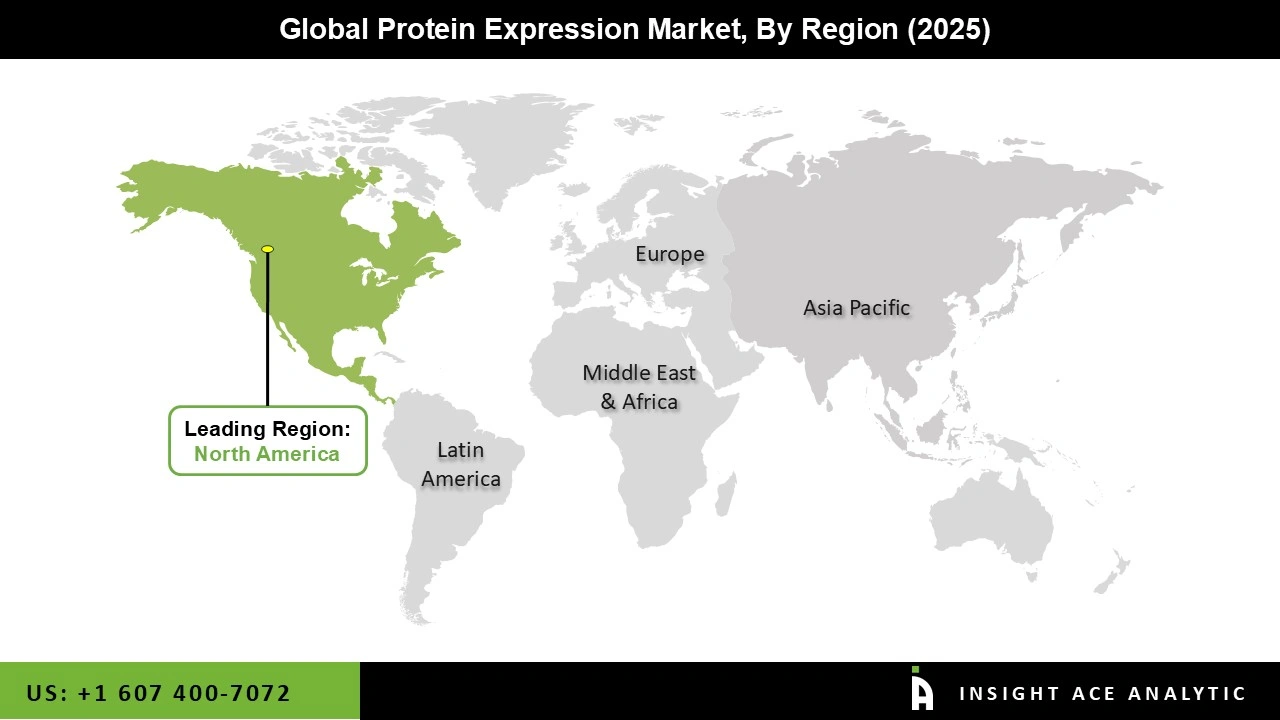
North America Has the Largest Market Share During the Forecast Period.
North America, particularly the United States, is home to a highly developed biotechnology and pharmaceutical sector. Leading companies and research institutions in these fields are driving demand for protein expression technologies for drug development, biologics, and biosimilars. The region benefits from substantial investment in R&D from both government bodies and private organizations.
This funding supports innovations in protein expression systems, enhancing productivity and fostering new therapeutic applications. The rising incidence of chronic diseases, such as cancer, diabetes, and autoimmune disorders, in North America creates a high demand for protein-based therapeutics like monoclonal antibodies and vaccines, fueling the protein expression market.
Recent Developments:
- In June 2024, Syngene International Ltd., A protein production platform was introduced by a global contract research, development, and manufacturing organization (CRDMO) to facilitate rapid production. The platform makes use of transposon- and cell line-based technology licensed from ExcellGene, a biotech services business with headquarters in Switzerland.
- In July 2024, Agilent Technologies Inc., announced at the Singapore Cell and Gene Therapy Pan Asia Summit (SCGT) the debut of its new ProteoAnalyzer system in addition to improvements to its current line of products. The automated parallel capillary electrophoresis (CE) solution from Agilent is a revolutionary protein analysis platform that combines quick, high-resolution analysis with less sample consumption. This facilitates the analysis of intricate protein blends by researchers, leading to expedited discoveries in the fields of pharma, biopharma, and bioengineered food ingredients.
Protein Expression Market Report Scope :
| Report Attribute | Specifications |
| Market Size Value In 2025 | USD 3.05 Bn |
| Revenue Forecast In 2035 | USD 7.03 Bn |
| Growth Rate CAGR | CAGR of 9.0% from 2026 to 2035 |
| Quantitative Units | Representation of revenue in US$ Bn and CAGR from 2026 to 2035 |
| Historic Year | 2022 to 2025 |
| Forecast Year | 2026 to 2035 |
| Report Coverage | The forecast of revenue, the position of the company, the competitive market structure, growth prospects, and trends |
| Segments Covered | Type Of Protein Expression System, Protein Expression-Related Offerings, Application Area, End-Users, and Type of Operation |
| Regional Scope | North America; Europe; Asia Pacific; Latin America; Middle East & Africa |
| Country Scope | U.S.; Canada; U.K.; Germany; China; India; Japan; Brazil; Mexico; France; Italy; Spain; South Korea; South East Asia |
| Competitive Landscape | Agilent Technologies, Ajinomoto Bio-Pharma Services, Aldevron, Cayman Chemical, Charles River Laboratories, Domainex, Eurofins CALIXAR, GeNext Genomics, GenScript Biotech, Lonza , Merck KGaA, New England Biolabs, ProMab, Promega , ProteoGenix, QIAGEN, and other prominent players |
| Customization Scope | Free customization report with the procurement of the report and modifications to the regional and segment scope. Particular Geographic competitive landscape. |
| Pricing and Available Payment Methods | Explore pricing alternatives that are customized to your particular study requirements. |
Segmentation of Protein Expression Market :
Protein Expression Market, By Type of Protein Expression System-
- Algal Expression Systems
- Cell-free Expression Systems
- Insect Expression Systems
- Mammalian Expression Systems
- Prokaryotic Expression Systems
- Yeast Expression Systems
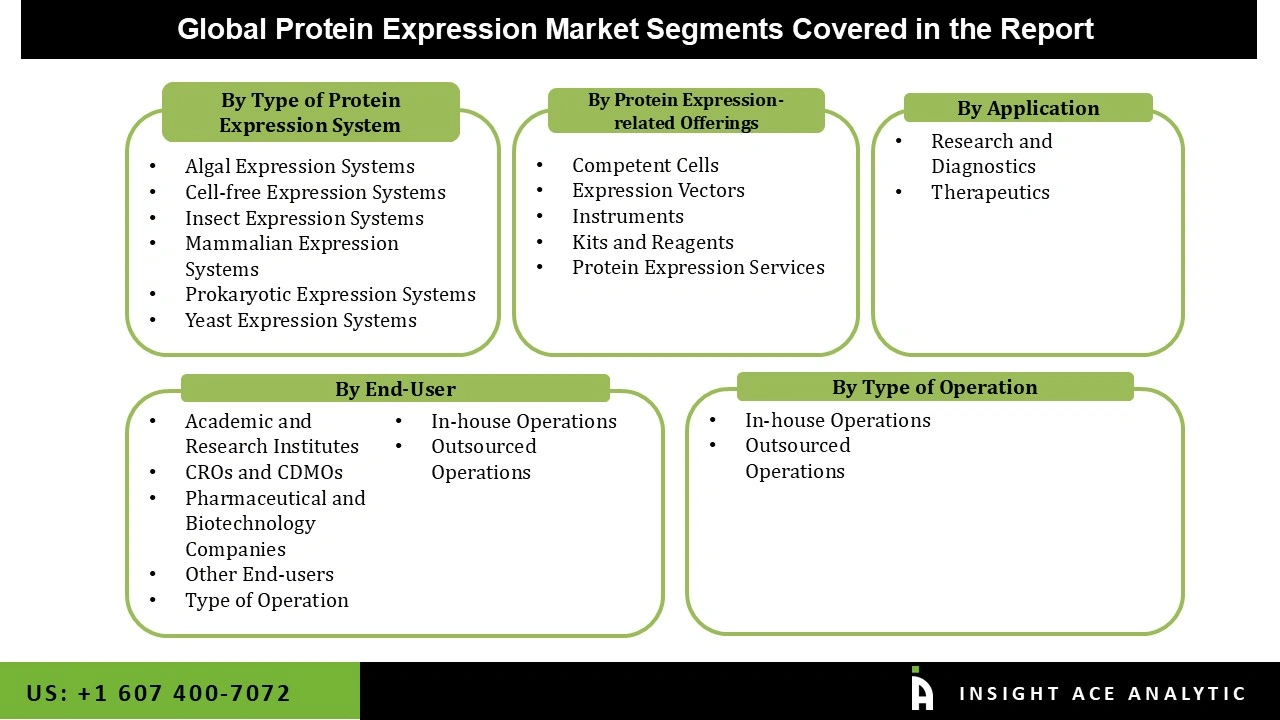
Protein Expression Market, Protein Expression-related Offerings -
- Competent Cells
- Expression Vectors
- Instruments
- Kits and Reagents
- Protein Expression Services
Protein Expression Market, By Application-
- Research and Diagnostics
- Therapeutics
Protein Expression Market, By End user-
- Academic and Research Institutes
- CROs and CDMOs
- Pharmaceutical and Biotechnology Companies
- Other End-users
- Type of Operation
- In-house Operations
- Outsourced Operations
Protein Expression Market ,Type of Operation-
- In-house Operations
- Outsourced Operations
Protein Expression Market, By Region-
- North America-
- The US
- Canada
- Europe-
- Germany
- The UK
- France
- Italy
- Spain
- Rest of Europe
- Asia-Pacific-
- China
- Japan
- India
- South Korea
- South East Asia
- Rest of Asia Pacific
- Latin America-
- Brazil
- Argentina
- Mexico
- Rest of Latin America
- Middle East & Africa-
- GCC Countries
- South Africa
- Rest of Middle East and Africa
Research Design and Approach
This study employed a multi-step, mixed-method research approach that integrates:
- Secondary research
- Primary research
- Data triangulation
- Hybrid top-down and bottom-up modelling
- Forecasting and scenario analysis
This approach ensures a balanced and validated understanding of both macro- and micro-level market factors influencing the market.
Secondary Research
Secondary research for this study involved the collection, review, and analysis of publicly available and paid data sources to build the initial fact base, understand historical market behaviour, identify data gaps, and refine the hypotheses for primary research.
Sources Consulted
Secondary data for the market study was gathered from multiple credible sources, including:
- Government databases, regulatory bodies, and public institutions
- International organizations (WHO, OECD, IMF, World Bank, etc.)
- Commercial and paid databases
- Industry associations, trade publications, and technical journals
- Company annual reports, investor presentations, press releases, and SEC filings
- Academic research papers, patents, and scientific literature
- Previous market research publications and syndicated reports
These sources were used to compile historical data, market volumes/prices, industry trends, technological developments, and competitive insights.

Primary Research
Primary research was conducted to validate secondary data, understand real-time market dynamics, capture price points and adoption trends, and verify the assumptions used in the market modelling.
Stakeholders Interviewed
Primary interviews for this study involved:
- Manufacturers and suppliers in the market value chain
- Distributors, channel partners, and integrators
- End-users / customers (e.g., hospitals, labs, enterprises, consumers, etc., depending on the market)
- Industry experts, technology specialists, consultants, and regulatory professionals
- Senior executives (CEOs, CTOs, VPs, Directors) and product managers
Interview Process
Interviews were conducted via:
- Structured and semi-structured questionnaires
- Telephonic and video interactions
- Email correspondences
- Expert consultation sessions
Primary insights were incorporated into demand modelling, pricing analysis, technology evaluation, and market share estimation.
Data Processing, Normalization, and Validation
All collected data were processed and normalized to ensure consistency and comparability across regions and time frames.
The data validation process included:
- Standardization of units (currency conversions, volume units, inflation adjustments)
- Cross-verification of data points across multiple secondary sources
- Normalization of inconsistent datasets
- Identification and resolution of data gaps
- Outlier detection and removal through algorithmic and manual checks
- Plausibility and coherence checks across segments and geographies
This ensured that the dataset used for modelling was clean, robust, and reliable.
Market Size Estimation and Data Triangulation
Bottom-Up Approach
The bottom-up approach involved aggregating segment-level data, such as:
- Company revenues
- Product-level sales
- Installed base/usage volumes
- Adoption and penetration rates
- Pricing analysis
This method was primarily used when detailed micro-level market data were available.

Top-Down Approach
The top-down approach used macro-level indicators:
- Parent market benchmarks
- Global/regional industry trends
- Economic indicators (GDP, demographics, spending patterns)
- Penetration and usage ratios
This approach was used for segments where granular data were limited or inconsistent.
Hybrid Triangulation Approach
To ensure accuracy, a triangulated hybrid model was used. This included:
- Reconciling top-down and bottom-up estimates
- Cross-checking revenues, volumes, and pricing assumptions
- Incorporating expert insights to validate segment splits and adoption rates
This multi-angle validation yielded the final market size.
Forecasting Framework and Scenario Modelling
Market forecasts were developed using a combination of time-series modelling, adoption curve analysis, and driver-based forecasting tools.
Forecasting Methods
- Time-series modelling
- S-curve and diffusion models (for emerging technologies)
- Driver-based forecasting (GDP, disposable income, adoption rates, regulatory changes)
- Price elasticity models
- Market maturity and lifecycle-based projections
Scenario Analysis
Given inherent uncertainties, three scenarios were constructed:
- Base-Case Scenario: Expected trajectory under current conditions
- Optimistic Scenario: High adoption, favourable regulation, strong economic tailwinds
- Conservative Scenario: Slow adoption, regulatory delays, economic constraints
Sensitivity testing was conducted on key variables, including pricing, demand elasticity, and regional adoption.
Request Customization
Add countries, segments, company profiles, or extend forecast — free 10% customization with purchase.
Customize This Report →Enquire Before Buying
Speak with our analyst team about scope, methodology, pricing, or deliverable formats.
Enquire Now →Frequently Asked Questions
Protein Expression Market Size is valued at USD 3.05 Bn in 2025 and is predicted to reach USD 7.03 Bn by the year 2035
The Protein Expression Market is expected to grow at an 9.0% CAGR during the forecast period for 2026 to 2035.
Agilent Technologies, Ajinomoto Bio-Pharma Services, Aldevron, Cayman Chemical, Charles River Laboratories, Domainex, Eurofins CALIXAR, GeNext Genomic
Protein Expression Market is Segmented in Type of Protein Expression System (Algal, Cell-free, Insect, Mammalian, Prokaryotic and Yeast), Protein Expression-related Offerings (Competent Cells, Expression Vectors, Instruments, Kits and Reagents, and Protein Expression Services), Application Aera, End-Users and Type of Operation.
North America region is leading the Protein Expression Market.