CBD API Market Size, Trend, Forecast Report 2026 to 2035
What is CBD API Market Size?
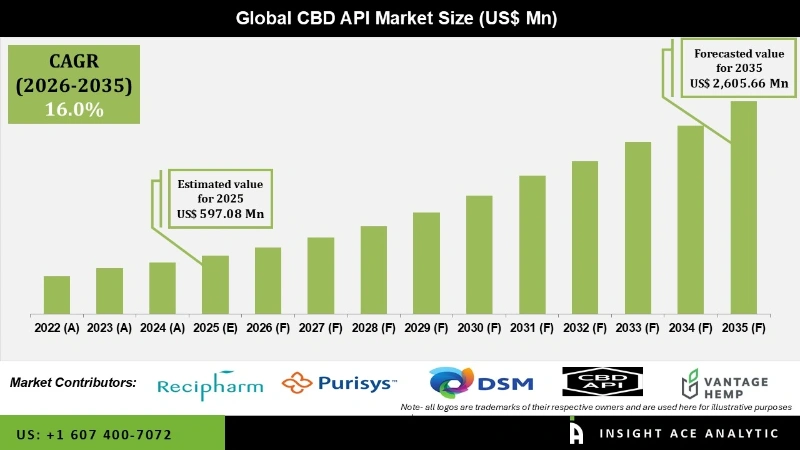
Global CBD API Market growth is valued at US$ 597.08 Mn in 2025 and is expected to reach US$ 2,605.66 Mn by 2035, with a CAGR of 16.0% during the forecast period of 2026 to 2035.
CBD API Market Size, Share & Trends Analysis Report By Source Type (Natural CBD API (Plant-Derived),Synthetic CBD API), By End Use / Application (Pharmaceuticals, Nutraceuticals & Dietary Supplements, Cosmetics & Personal Care, Research & Development / Clinical Use), By End User (Pharmaceutical & Biotech Companies, Nutraceutical / Supplement Manufacturers, Cosmetic & Personal Care Companies, Contract Manufacturing Organizations (CMOs) / CDMOs, Research Institutions & CROs), By Purity / Grade, By Form / Composition, By Region and By Segment Forecasts, 2026 to 2035.
CBD API Market Key Takeaways:
|
Key Industry Insights & Findings from the report:
- CBD has been recommended for a range of health conditions, it is considered the best treatment while considering the worst childhood epilepsy disorders.
- The increasing demand for health and wellness, and natural remedies is expected to drive industry growth.
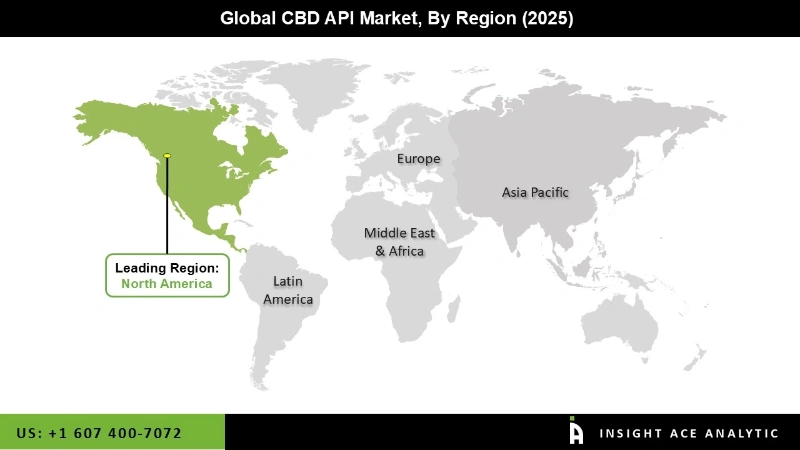
- North America dominated the market and accounted for a global revenue share in 2024.
- One of the significant concerns restraining industry growth is the high market price of CBD due to extensive research and medical benefits.
While cannabis includes over one hundred distinct cannabinoids, such as tetrahydrocannabinol (THC) and lesser cannabinoids, such as CBN and CBG, CBD is the most well-known. CBD binds to multiple cell receptors throughout the body, directly and indirectly revealing its extensive medicinal potential. Cannabidiol (CBD) research is developing rapidly, providing clinical support for the human body, mind, and emotions. Each cannabinoid possesses unique characteristics, medicinal capabilities, chemical structure, and advantages. CBD is frequently extracted and manufactured into CBD-based oils, tinctures, topical creams, and edibles due to its versatility and well-tolerated nature.
All cannabinoids produce therapeutic effects through interaction with the endocannabinoid system (ECS), and CBD is not dissimilar. The ECS is a complex cell signalling system in all animals, composed of endocannabinoids and receptors. CBD regulates a variety of biological processes, including pain perception, emotion, sleep, and immunological response. Cannabidiol is very sensitive for the human body as it shows various side effects. EPIDIOLEX is the first prescription CBD product approved by the FDA for the treatment of seizures associated with Lennox-Gastaut syndrome (LGS), Dravet syndrome, or tuberous sclerosis complex (TSC) in individuals aged one year and older. It implies that clinical trials have thoroughly examined its safety and efficacy profile.
The market is primarily driven by the rising demand for Cannabidiol (CBD) for health and well-being applications. Cannabidiol is beneficial for treating anxiety and seizures and lowering pain. Due to the absence of psychotropic effects, Cannabidiol is the cannabinoid most commonly used for therapeutic purposes, and it is in great demand for health and wellness purposes, which is the primary market driver. In addition, the increasing acceptability and use of products as a result of regulatory approvals is a significant driver that is anticipated to increase the manufacturing of CBD-infused products. In addition, government funding for therapeutic research and collaborations with prominent market players will enhance the development and demand for CBD as an API.
As CBD is a very delicate chemical compound for therapeutic use, FDA is approving CBD-derived drugs very carefully; hence only one drug has been approved yet. Such delays in approvals will impact the global demand for CBD as an API. The high cost of this market is the most significant obstacle they face. Since they are associated with medical advantages and necessitate extensive research to prepare products, they are unaffordable to most of the population. This is a crucial impediment to the expansion of the CBD business.
Competetive Landscape
- Axplora / Farmabios
- Transo-Pharm USA LLC
- Biophore India Pharmaceuticals Pvt. Ltd.
- Veranova
- Cohance Lifesciences
- Malladi Drugs & Pharmaceuticals Ltd.
- Noramco / Purisys
- Farmhispania
- SCI Pharmtech
- Alkem Laboratories
- Arene Lifesciences
- Arevipharma
- Averix Bio
- Celadon Pharmaceuticals
- Embio Limited
- Farmakem
- DSM-Firmenich
- KD Pharma Group / KD Phyto
- Biovectra
- Hyasynth
- Indena
- Bedrocan
- Vantage Hemp
- CB21 Pharma
- Brains Bioceutical
- Others
Market Segmentation
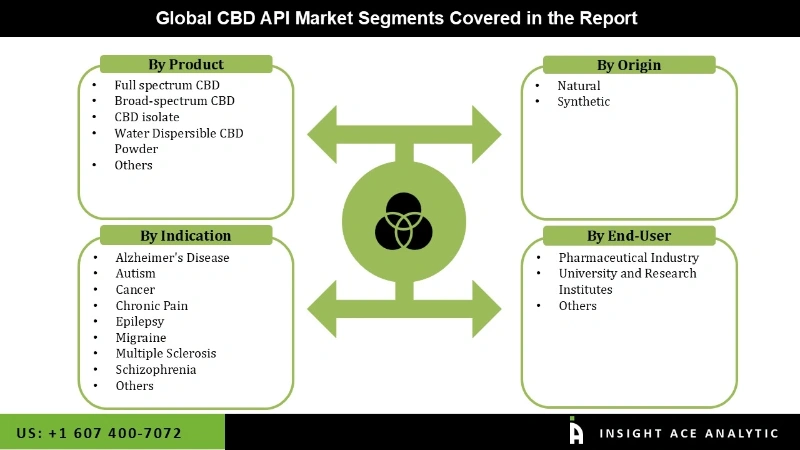
The CBD API market is segmented into three segments. The first segment is by product, including Full spectrum CBD, Broad-spectrum CBD, CBD isolate, and Others. The other segment is by Origin, which has two divisions, synthetic and natural, in which natural Origin is very much demanding in the current market. The third segment is Indication, which comprises Alzheimer's Disease, Autism, Cancer, Chronic Pain, Epilepsy, Psychosis, Anxiety & Depression, Obesity/weight loss, and Others. By Route of Administration segment the market includes Oral, Topical, Intravenous, Others.
Regionally, North America dominated the Cannabidiol (CBD) API market, which is anticipated to continue during the forecast period. Most of the CBD providers are present in the North American region, and the investments are at the peak for research and development on Cannabidiol-derived therapies.
Recent Developments
- In April 2023, Vantage Hemp Co. submitted a DMF for its CBD Isolate to the FDA. The FDA needed the submission (DMF #037784) to produce safe and effective CBD products. This engagement established the Company as a transparent and dependable partner to clients and regulators.
- In April 2022, Averix Bio and Geocann have established a strategic alliance for distributing pharmaceutical API phytocannabinoid constituents, which were developed utilizing a drug delivery system technology that has been empirically validated in the marketplace.
CBD API Market Report Scope :
| Report Attribute | Specifications |
| Market Size Value In 2025 | USD 597.08 Mn |
| Revenue Forecast In 2035 | USD 2,605.66 Mn |
| Growth Rate CAGR | CAGR of 16.0% from 2026 to 2035 |
| Quantitative Units | Representation of revenue in US$ Million and CAGR from 2026 to 2035 |
| Historic Year | 2022 to 2025 |
| Forecast Year | 2026-2035 |
| Report Coverage | The forecast of revenue, the position of the company, the competitive market structure, growth prospects, and trends |
| Segments Covered | Source Type, End Use / Application, End User , Purity/Grade and Form / Composition |
| Regional Scope | North America; Europe; Asia Pacific; Latin America; Middle East & Africa |
| Country Scope | U.S.; Canada; U.K.; Germany; China; India; Japan; Brazil; Mexico; France; Italy; Spain; South Korea; South East Asia |
| Competitive Landscape | Axplora / Farmabios, Transo-Pharm USA LLC, Biophore India Pharmaceuticals Pvt. Ltd., Veranova, Cohance Lifesciences, Malladi Drugs & Pharmaceuticals Ltd., Noramco / Purisys, Farmhispania, SCI Pharmtech, Alkem Laboratories, Arene Lifesciences, Arevipharma, Averix Bio, Celadon Pharmaceuticals, Embio Limited, Farmakem, DSM-Firmenich, KD Pharma Group / KD Phyto, Biovectra, Hyasynth, Indena, Bedrocan, Vantage Hemp, CB21 Pharma, Brains Bioceutical, Others |
| Customization Scope | Free customization report with the procurement of the report, Modifications to the regional and segment scope. Particular Geographic competitive landscape. |
| Pricing And Available Payment Methods | Explore pricing alternatives that are customized to your particular study requirements. |
Segmentation of CBD API Market :
CBD API Market, By Source Type-
- Natural CBD API (Plant-Derived)
- Synthetic CBD API
CBD API Market, By End Use / Application-
- Pharmaceuticals
- Nutraceuticals & Dietary Supplements
- Cosmetics & Personal Care
- Research & Development / Clinical Use
CBD API Market, By Purity / Grade-
- Pharmaceutical-Grade (≥99% purity, GMP-certified)
- Industrial / Technical Grade (85–98% purity)
CBD API Market, By End-User-
- Pharmaceutical & Biotech Companies
- Nutraceutical / Supplement Manufacturers
- Cosmetic & Personal Care Companies
- Contract Manufacturing Organizations (CMOs) / CDMOs
- Research Institutions & CROs
CBD API Market, By Form / Composition-
- CBD Isolate (Pure CBD, no other cannabinoids)
- Broad-Spectrum CBD (Multiple cannabinoids, THC-free)
- Full-Spectrum CBD (Includes trace THC <0.3%)
CBD API Market, By Region,
North America-
- The US
- Canada
Europe-
- Germany
- The UK
- France
- Italy
- Spain
- Rest of Europe
Asia-Pacific-
- China
- Japan
- India
- South Korea
- South East Asia
- Rest of Asia Pacific
Latin America-
- Brazil
- Mexico
- Argentina
- Rest of Latin America
Middle East & Africa-
- GCC Countries
- South Africa
- Rest of Middle East and Africa
Research Design and Approach
This study employed a multi-step, mixed-method research approach that integrates:
- Secondary research
- Primary research
- Data triangulation
- Hybrid top-down and bottom-up modelling
- Forecasting and scenario analysis
This approach ensures a balanced and validated understanding of both macro- and micro-level market factors influencing the market.
Secondary Research
Secondary research for this study involved the collection, review, and analysis of publicly available and paid data sources to build the initial fact base, understand historical market behaviour, identify data gaps, and refine the hypotheses for primary research.
Sources Consulted
Secondary data for the market study was gathered from multiple credible sources, including:
- Government databases, regulatory bodies, and public institutions
- International organizations (WHO, OECD, IMF, World Bank, etc.)
- Commercial and paid databases
- Industry associations, trade publications, and technical journals
- Company annual reports, investor presentations, press releases, and SEC filings
- Academic research papers, patents, and scientific literature
- Previous market research publications and syndicated reports
These sources were used to compile historical data, market volumes/prices, industry trends, technological developments, and competitive insights.

Primary Research
Primary research was conducted to validate secondary data, understand real-time market dynamics, capture price points and adoption trends, and verify the assumptions used in the market modelling.
Stakeholders Interviewed
Primary interviews for this study involved:
- Manufacturers and suppliers in the market value chain
- Distributors, channel partners, and integrators
- End-users / customers (e.g., hospitals, labs, enterprises, consumers, etc., depending on the market)
- Industry experts, technology specialists, consultants, and regulatory professionals
- Senior executives (CEOs, CTOs, VPs, Directors) and product managers
Interview Process
Interviews were conducted via:
- Structured and semi-structured questionnaires
- Telephonic and video interactions
- Email correspondences
- Expert consultation sessions
Primary insights were incorporated into demand modelling, pricing analysis, technology evaluation, and market share estimation.
Data Processing, Normalization, and Validation
All collected data were processed and normalized to ensure consistency and comparability across regions and time frames.
The data validation process included:
- Standardization of units (currency conversions, volume units, inflation adjustments)
- Cross-verification of data points across multiple secondary sources
- Normalization of inconsistent datasets
- Identification and resolution of data gaps
- Outlier detection and removal through algorithmic and manual checks
- Plausibility and coherence checks across segments and geographies
This ensured that the dataset used for modelling was clean, robust, and reliable.
Market Size Estimation and Data Triangulation
Bottom-Up Approach
The bottom-up approach involved aggregating segment-level data, such as:
- Company revenues
- Product-level sales
- Installed base/usage volumes
- Adoption and penetration rates
- Pricing analysis
This method was primarily used when detailed micro-level market data were available.

Top-Down Approach
The top-down approach used macro-level indicators:
- Parent market benchmarks
- Global/regional industry trends
- Economic indicators (GDP, demographics, spending patterns)
- Penetration and usage ratios
This approach was used for segments where granular data were limited or inconsistent.
Hybrid Triangulation Approach
To ensure accuracy, a triangulated hybrid model was used. This included:
- Reconciling top-down and bottom-up estimates
- Cross-checking revenues, volumes, and pricing assumptions
- Incorporating expert insights to validate segment splits and adoption rates
This multi-angle validation yielded the final market size.
Forecasting Framework and Scenario Modelling
Market forecasts were developed using a combination of time-series modelling, adoption curve analysis, and driver-based forecasting tools.
Forecasting Methods
- Time-series modelling
- S-curve and diffusion models (for emerging technologies)
- Driver-based forecasting (GDP, disposable income, adoption rates, regulatory changes)
- Price elasticity models
- Market maturity and lifecycle-based projections
Scenario Analysis
Given inherent uncertainties, three scenarios were constructed:
- Base-Case Scenario: Expected trajectory under current conditions
- Optimistic Scenario: High adoption, favourable regulation, strong economic tailwinds
- Conservative Scenario: Slow adoption, regulatory delays, economic constraints
Sensitivity testing was conducted on key variables, including pricing, demand elasticity, and regional adoption.
Request Customization
Add countries, segments, company profiles, or extend forecast — free 10% customization with purchase.
Customize This Report →Enquire Before Buying
Speak with our analyst team about scope, methodology, pricing, or deliverable formats.
Enquire Now →Frequently Asked Questions
The Global CBD API Market growth is predicted at a 16.0% CAGR during the forecast period for 2026-2035.
CBD API Market Companies are Axplora / Farmabios, Transo-Pharm USA LLC, Biophore India Pharmaceuticals Pvt. Ltd., Veranova, Cohance Lifesciences, Malladi Drugs & Pharmaceuticals Ltd., Noramco / Purisys, Farmhispania, SCI Pharmtech, Alkem Laboratories, Arene Lifesciences, Arevipharma, Averix Bio, Celadon Pharmaceuticals, Embio Limited, Farmakem, DSM-Firmenich, KD Pharma Group / KD Phyto, Biovectra, Hyasynth, Indena, Bedrocan, Vantage Hemp, CB21 Pharma, Brains Bioceutical, Others
CBD API Market growth is valued at US$ 597.08 Mn in 2025 and is expected to reach US$ 2,605.66 Mn by 2035.
CBD API market is segmented into CBD, Broad-spectrum CBD, CBD isolate, and Others.
North American region is leading the CBD API Market.