Disposable Surgical Sheet Market Size, Share, Forecast Report 2026 to 2035
What is Disposable Surgical Sheet Market Size?
Disposable Surgical Sheet Market Size is valued at USD 4.3 Billion in 2025 and is predicted to reach USD 6.58 Billion by the year 2035 at a 4.4% CAGR during the forecast period for 2026 to 2035.
Disposable Surgical Sheet Market Size, Share & Trends Analysis Report By Product (Drapes, Gowns, Sheets, Others), By Application (Polypropylene, Polyethylene, Rayon, Others), By Usability (Disposable, Reusable), By sterility (Sterile, Non-Sterile), By End-User, By Region, And By Segment Forecasts, 2026 to 2035.
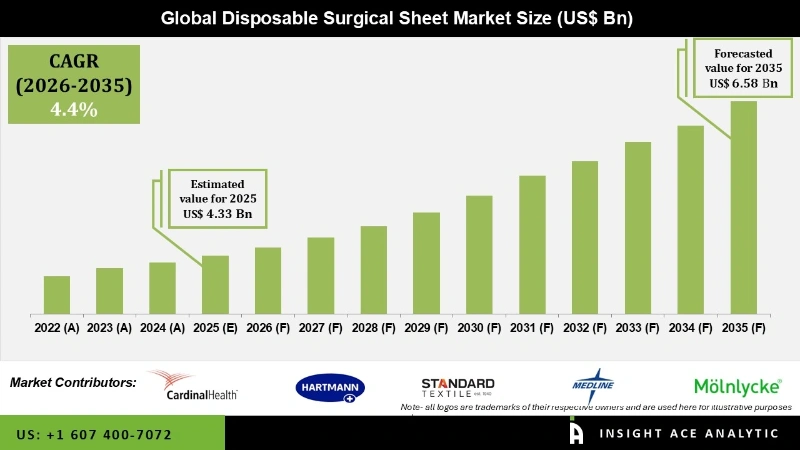
Disposable Surgical Sheet Market Key Takeaways:
|
A disposable surgical sheet is a sterile and single-use covering composed of materials such as non-woven fabric or plastic. It serves as a protective barrier during surgical procedures, safeguarding patients and equipment from pollutants. These sheets come in many sizes and forms, meet infection control standards, are easy to use once, and typically repel fluids. They help maintain sterile conditions in the operating room and are discarded after each surgical procedure.
The rise in surgical procedures globally is a significant factor fueling the demand for disposable surgical sheets. Healthcare providers, guided by stringent regulations and guidelines, are increasingly incorporating these single-use products to ensure compliance with industry standards. Advancements in material technology play a crucial role in enhancing the performance of disposable sheets, with ongoing innovations improving properties such as barrier protection and comfort. While posing certain challenges, sustainability considerations also act as a market driver. Some disposable surgical sheets are designed with eco-friendly materials, aligning with the broader trend of environmentally conscious healthcare practices. Cost-effectiveness contributes to adopting disposable sheets, especially in more economical scenarios than traditional reusable options.
Furthermore, the market's growth is further supported by the prevalence of infectious diseases, including global events, underscoring the importance of robust infection prevention measures and the COVID-19 pandemic. Intense competition among manufacturers has spurred innovation, with companies striving to differentiate their products through features like improved adhesiveness and antimicrobial properties. Additionally, the ease of disposal associated with disposable surgical sheets aligns with evolving healthcare practices, including a shift toward outpatient procedures and minimally invasive surgeries. The well-developed infrastructure in the healthcare sector, coupled with the rising healthcare expenditure, acts as a solid foundation for the market's expansion.
Competitive Landscape
Some Major Key Players In The Disposable Surgical Sheet Market:
- Cardinal Health
- Molnlycke Health Care
- Paul Hartmann AG
- Standard Textile Co.
- Medline Industries Inc.
- Molnlycke Health Care AB
- 3M Healthcare
- Ahlstrom-Munksjo
- Winner Medical Co. Ltd.
- Kimberly-Clark Health Care
- DuPont Medical Fabrics
- Johnson & Johnson
- Braun Melsungen AG
- Premier,
- Ansell Limited
- Others
Market Segmentation:
The disposable surgical sheet market is segmented based on product, application, usability, and sterility. The market is segmented as drapes, gowns, sheets, and others based on product. The market is segmented by application into polypropylene, polyethylene, rayon, and others. By usability, the disposable surgical sheet market is segmented into disposable and reusable. By sterility, the market is segmented as sterile and non-sterile. The end-user segment comprises Hospitals, Clinics, Diagnostic Centers, Ambulatory Surgical Centers, and Others.
In Terms Of Product, The Drapes Market Held The Highest Market Share In 2022.
Drapes are essential for preserving sterility during surgical procedures as they establish a sterile environment around the operating area. Their demand is fueled by the increasing prevalence of operations worldwide.
Based On Usability, The Disposable Segment Is A Major Contributor To The Disposable Surgical Sheet Market.
The disposable category will hold a major share of the global Disposable Surgical Sheet market in 2022. The widespread use of disposable drapes and the increasing recognition of disposable surgical drapes are propelling the growth of the segment. Typically crafted from non-woven materials, these drapes are discarded after each surgical procedure. Non-woven fabric is favoured over woven fabric due to its superior protection against hospital-acquired diseases and surgical-site infections. It boasts lightweight nature, cost-effectiveness, straightforward recycling procedures, and reduced manufacturing expenses. Additionally, in comparison to reusable surgical drapes, disposable drapes exhibit resistance to liquids, abrasion, and tearing. Consequently, the benefits of non-woven fabric foster the demand for disposable surgical drapes.
The Hospital Category Witnessed Growth At A Rapid Rate.
The hospital segment is projected to develop at a rapid rate in the global disposable surgical sheet market. Hospitals are the initial consumers of surgical drapes, given that most surgeries worldwide occur within hospital settings. The escalating incidence of Surgical Site Infections (SSI) further amplifies hospitals' demand for surgical drapes. Additionally, the ongoing construction of new hospitals, supported by increased government investments, contributes significantly to this segment's expansion.
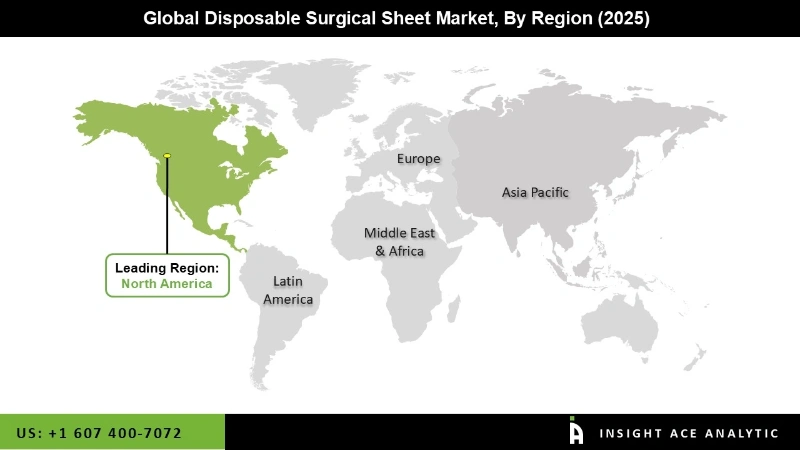
The North America Disposable Surgical Sheet Market Holds A Significant Revenue Share In The Region.
The North America Disposable Surgical Sheet market is expected to register a tremendous market share in revenue shortly. There is a growing awareness and learning of environmental sustainability in North America. This may influence the market, with some manufacturers developing eco-friendly disposable surgical sheets to address environmental concerns. North America has well-established and stringent healthcare regulations. Compliance with these regulations is a key driver for adopting disposable surgical sheets to meet infection control and patient safety standards. The healthcare industry in North America is competitive, and this competition can drive innovation and the development of high-quality disposable surgical sheets. In addition, Asia Pacific is estimated to grow rapidly in the global disposable surgical sheet market, a hub for medical technology innovations. Advancements in material technology and integrating features such as antimicrobial properties can influence the adoption of disposable surgical sheets.
Recent Developments:
- In March 2023, Cardinal Health developed a novel surgical drape with the aim of mitigating the likelihood of surgical site contamination. The drape showcased Avery Dennison's unique BeneHold™ CHG adhesive technology, which effectively minimized the likelihood of surgical site contamination by organisms commonly linked to surgical site infections (SSIs).
- In March 2021, Ansell Limited acquired the Primus trademark and associated assets, which include the Life Science business owned by Primus Gloves and Sanrea Healthcare Products (Primus). Ansell has established a durable supply alliance with Primus Gloves and Sanrea Healthcare Products.
Disposable Surgical Sheet Market Report Scope
| Report Attribute | Specifications |
| Market Size Value In 2025 | USD 4.33 Billion |
| Revenue Forecast In 2035 | USD 6.58 Billion |
| Growth Rate CAGR | CAGR of 4.4% from 2026 to 2035 |
| Quantitative Units | Representation of revenue in US$ Million and CAGR from 2026 to 2035 |
| Historic Year | 2022 to 2025 |
| Forecast Year | 2026-2035 |
| Report Coverage | The forecast of revenue, the position of the company, the competitive market structure, growth prospects, and trends |
| Segments Covered | By Product, By Application, By Usability, By sterility, By End-User |
| Regional Scope | North America; Europe; Asia Pacific; Latin America; Middle East & Africa |
| Country Scope | U.S.; Canada; U.K.; Germany; China; India; Japan; Brazil; Mexico; France; Italy; Spain; South East Asia; South Korea |
| Competitive Landscape | Cardinal Health, Paul Hartmann AG, Standard Textile Co., Medline Industries Inc., Molnlycke Health Care AB, 3M Healthcare, Ahlstrom-Munksjo, Winner Medical Co. Ltd., Kimberly-Clark Health Care, DuPont Medical Fabrics, Johnson & Johnson, B. Braun Melsungen AG, Premier, Ansell Limited |
| Customization Scope | Free customization report with the procurement of the report and modifications to the regional and segment scope. Particular Geographic competitive landscape. |
| Pricing And Available Payment Methods | Explore pricing alternatives that are customized to your particular study requirements. |
Segmentation of Disposable Surgical Sheet Market-
Disposable Surgical Sheet Market By Product-
- Drapes
- Gowns
- Sheets
- Others
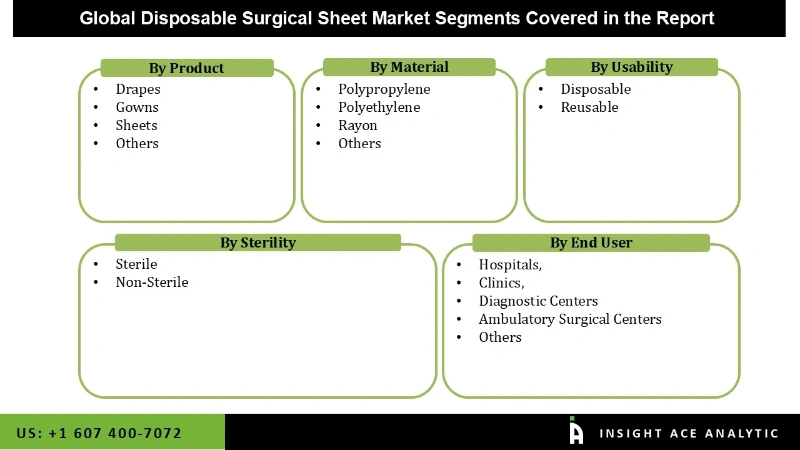
Disposable Surgical Sheet Market By Material-
- Polypropylene
- Polyethylene
- Rayon
- Others
Disposable Surgical Sheet Market By Usability
- Disposable
- Reusable
Disposable Surgical Sheet Market By sterility
- Sterile
- Non-Sterile
Disposable Surgical Sheet Market By End User
- Hospitals,
- Clinics,
- Diagnostic Centers
- Ambulatory Surgical Centers
- Others
Disposable Surgical Sheet Market By Region-
North America-
- The US
- Canada
- Mexico
Europe-
- Germany
- The UK
- France
- Italy
- Spain
- Rest of Europe
Asia-Pacific-
- China
- Japan
- India
- South Korea
- South East Asia
- Rest of Asia Pacific
Latin America-
- Brazil
- Argentina
- Rest of Latin America
Middle East & Africa-
- GCC Countries
- South Africa
- Rest of Middle East and Africa
Research Design and Approach
This study employed a multi-step, mixed-method research approach that integrates:
- Secondary research
- Primary research
- Data triangulation
- Hybrid top-down and bottom-up modelling
- Forecasting and scenario analysis
This approach ensures a balanced and validated understanding of both macro- and micro-level market factors influencing the market.
Secondary Research
Secondary research for this study involved the collection, review, and analysis of publicly available and paid data sources to build the initial fact base, understand historical market behaviour, identify data gaps, and refine the hypotheses for primary research.
Sources Consulted
Secondary data for the market study was gathered from multiple credible sources, including:
- Government databases, regulatory bodies, and public institutions
- International organizations (WHO, OECD, IMF, World Bank, etc.)
- Commercial and paid databases
- Industry associations, trade publications, and technical journals
- Company annual reports, investor presentations, press releases, and SEC filings
- Academic research papers, patents, and scientific literature
- Previous market research publications and syndicated reports
These sources were used to compile historical data, market volumes/prices, industry trends, technological developments, and competitive insights.

Primary Research
Primary research was conducted to validate secondary data, understand real-time market dynamics, capture price points and adoption trends, and verify the assumptions used in the market modelling.
Stakeholders Interviewed
Primary interviews for this study involved:
- Manufacturers and suppliers in the market value chain
- Distributors, channel partners, and integrators
- End-users / customers (e.g., hospitals, labs, enterprises, consumers, etc., depending on the market)
- Industry experts, technology specialists, consultants, and regulatory professionals
- Senior executives (CEOs, CTOs, VPs, Directors) and product managers
Interview Process
Interviews were conducted via:
- Structured and semi-structured questionnaires
- Telephonic and video interactions
- Email correspondences
- Expert consultation sessions
Primary insights were incorporated into demand modelling, pricing analysis, technology evaluation, and market share estimation.
Data Processing, Normalization, and Validation
All collected data were processed and normalized to ensure consistency and comparability across regions and time frames.
The data validation process included:
- Standardization of units (currency conversions, volume units, inflation adjustments)
- Cross-verification of data points across multiple secondary sources
- Normalization of inconsistent datasets
- Identification and resolution of data gaps
- Outlier detection and removal through algorithmic and manual checks
- Plausibility and coherence checks across segments and geographies
This ensured that the dataset used for modelling was clean, robust, and reliable.
Market Size Estimation and Data Triangulation
Bottom-Up Approach
The bottom-up approach involved aggregating segment-level data, such as:
- Company revenues
- Product-level sales
- Installed base/usage volumes
- Adoption and penetration rates
- Pricing analysis
This method was primarily used when detailed micro-level market data were available.

Top-Down Approach
The top-down approach used macro-level indicators:
- Parent market benchmarks
- Global/regional industry trends
- Economic indicators (GDP, demographics, spending patterns)
- Penetration and usage ratios
This approach was used for segments where granular data were limited or inconsistent.
Hybrid Triangulation Approach
To ensure accuracy, a triangulated hybrid model was used. This included:
- Reconciling top-down and bottom-up estimates
- Cross-checking revenues, volumes, and pricing assumptions
- Incorporating expert insights to validate segment splits and adoption rates
This multi-angle validation yielded the final market size.
Forecasting Framework and Scenario Modelling
Market forecasts were developed using a combination of time-series modelling, adoption curve analysis, and driver-based forecasting tools.
Forecasting Methods
- Time-series modelling
- S-curve and diffusion models (for emerging technologies)
- Driver-based forecasting (GDP, disposable income, adoption rates, regulatory changes)
- Price elasticity models
- Market maturity and lifecycle-based projections
Scenario Analysis
Given inherent uncertainties, three scenarios were constructed:
- Base-Case Scenario: Expected trajectory under current conditions
- Optimistic Scenario: High adoption, favourable regulation, strong economic tailwinds
- Conservative Scenario: Slow adoption, regulatory delays, economic constraints
Sensitivity testing was conducted on key variables, including pricing, demand elasticity, and regional adoption.
Request Customization
Add countries, segments, company profiles, or extend forecast — free 10% customization with purchase.
Customize This Report →Enquire Before Buying
Speak with our analyst team about scope, methodology, pricing, or deliverable formats.
Enquire Now →Frequently Asked Questions
Disposable Surgical Sheet Market Size is valued at USD 4.3 Billion in 2025 and is predicted to reach USD 6.58 Billion by the year 2035.
Disposable Surgical Sheet Market expected to grow at a 4.4% CAGR during the forecast period for 2026-2035.
Kimberly-Clark Health Care, DuPont Medical Fabrics, Johnson & Johnson, B. Braun Melsungen AG, Premier, Ansell Limited
Disposable surgical sheet market is segmented based on product, application, usability, and sterility.
North American region is leading the Disposable Surgical Sheet Market.