Robotic Nurses Market Size, Share & Trends Analysis Report By Product Type (Autonomous Mobile Robots, Independence Support Robots, Daily Care & Transportation Robots), By Application (Patient Care, Patient Transport, Surgery Assistance, Rehabilitation, Others), By End-User, By Region, And By Segment Forecasts, 2025-2034
Segmentation Of Robotic Nurses Market-
By Product Type-
- Autonomous Mobile Robots
- Independence Support Robots
- Daily Care & Transportation Robots
By Application
- Patient Care
- Patient Transport
- Surgery Assistance
- Rehabilitation
- Others
By End-User-
- Hospitals
- Specialty Clinics
- Ambulatory care Settings
- Research Organizations
By Region-
North America-
- The US
- Canada
Europe-
- Germany
- The UK
- France
- Italy
- Spain
- Rest of Europe
Asia-Pacific-
- China
- Japan
- India
- South Korea
- South East Asia
- Rest of Asia Pacific
Latin America-
- Brazil
- Argentina
- Mexico
- Rest of Latin America
Middle East & Africa-
- GCC Countries
- South Africa
- Rest of the Middle East and Africa
Chapter 1. Methodology and Scope
1.1. Research Methodology
1.2. Research Scope & Assumptions
Chapter 2. Executive Summary
Chapter 3. Global Robotic Nurses Market Snapshot
Chapter 4. Global Robotic Nurses Market Variables, Trends & Scope
4.1. Market Segmentation & Scope
4.2. Drivers
4.3. Challenges
4.4. Trends
4.5. Investment and Funding Analysis
4.6. Porter's Five Forces Analysis
4.7. Incremental Opportunity Analysis (US$ MN), 2024-2034
4.8. Global Robotic Nurses Market Penetration & Growth Prospect Mapping (US$ Mn), 2023-2031
4.9. Competitive Landscape & Market Share Analysis, By Key Player (2023)
4.10. Use/impact of AI on Robotic Nurses Market Industry Trends
Chapter 5. Robotic Nurses Market Segmentation 1: By Product Type, Estimates & Trend Analysis
5.1. Market Share by Product Type, 2024 & 2034
5.2. Market Size (Value (US$ Mn) & Forecasts and Trend Analyses, 2021 to 2034 for the following Product Type:
5.2.1. Autonomous Mobile Robots
5.2.2. Independence Support Robots
5.2.3. Daily Care & Transportation Robots
Chapter 6. Robotic Nurses Market Segmentation 2: By Application, Estimates & Trend Analysis
6.1. Market Share by Application, 2024 & 2034
6.2. Market Size (Value (US$ Mn) & Forecasts and Trend Analyses, 2021 to 2034 for the following Application:
6.2.1. Patient Care
6.2.2. Patient Transport
6.2.3. Surgery Assistance
6.2.4. Rehabilitation
6.2.5. Others
Chapter 7. Robotic Nurses Market Segmentation 3: By End-User, Estimates & Trend Analysis
7.1. Market Share by End-User, 2024 & 2034
7.2. Market Size (Value (US$ Mn) & Forecasts and Trend Analyses, 2021 to 2034 for the following End-User:
7.2.1. Hospitals
7.2.2. Specialty Clinics
7.2.3. Ambulatory care Settings
7.2.4. Research Organizations
Chapter 8. Robotic Nurses Market Segmentation 4: Regional Estimates & Trend Analysis
8.1. Global Robotic Nurses Market, Regional Snapshot 2024 & 2034
8.2. North America
8.2.1. North America Robotic Nurses Market Revenue (US$ Mn) Estimates and Forecasts by Country, 2021-2034
8.2.1.1. US
8.2.1.2. Canada
8.2.2. North America Robotic Nurses Market Revenue (US$ Mn) Estimates and Forecasts by Product Type, 2021-2034
8.2.3. North America Robotic Nurses Market Revenue (US$ Mn) Estimates and Forecasts by Application, 2021-2034
8.2.4. North America Robotic Nurses Market Revenue (US$ Mn) Estimates and Forecasts by End-User, 2021-2034
8.3. Europe
8.3.1. Europe Robotic Nurses Market Revenue (US$ Mn) Estimates and Forecasts by Country, 2021-2034
8.3.1.1. Germany
8.3.1.2. U.K.
8.3.1.3. France
8.3.1.4. Italy
8.3.1.5. Spain
8.3.1.6. Rest of Europe
8.3.2. Europe Robotic Nurses Market Revenue (US$ Mn) Estimates and Forecasts by Product Type, 2021-2034
8.3.3. Europe Robotic Nurses Market Revenue (US$ Mn) Estimates and Forecasts by Application, 2021-2034
8.3.4. Europe Robotic Nurses Market Revenue (US$ Mn) Estimates and Forecasts by End-User, 2021-2034
8.4. Asia Pacific
8.4.1. Asia Pacific Robotic Nurses Market Revenue (US$ Mn) Estimates and Forecasts by Country, 2021-2034
8.4.1.1. India
8.4.1.2. China
8.4.1.3. Japan
8.4.1.4. Australia
8.4.1.5. South Korea
8.4.1.6. Hong Kong
8.4.1.7. Southeast Asia
8.4.1.8. Rest of Asia Pacific
8.4.2. Asia Pacific Robotic Nurses Market Revenue (US$ Mn) Estimates and Forecasts by Product Type, 2021-2034
8.4.3. Asia Pacific Robotic Nurses Market Revenue (US$ Mn) Estimates and Forecasts by Application, 2021-2034
8.4.4. Asia Pacific Robotic Nurses Market Revenue (US$ Mn) Estimates and Forecasts by End-User, 2021-2034
8.5. Latin America
8.5.1. Latin America Robotic Nurses Market Revenue (US$ Mn) Estimates and Forecasts by Country, 2021-2034
8.5.1.1. Brazil
8.5.1.2. Mexico
8.5.1.3. Rest of Latin America
8.5.2. Latin America Robotic Nurses Market Revenue (US$ Mn) Estimates and Forecasts by Product Type, 2021-2034
8.5.3. Latin America Robotic Nurses Market Revenue (US$ Mn) Estimates and Forecasts by Application, 2021-2034
8.5.4. Latin America Robotic Nurses Market Revenue (US$ Mn) Estimates and Forecasts by End-User, 2021-2034
8.6. Middle East & Africa
8.6.1. Middle East & Africa Robotic Nurses Market Revenue (US$ Mn) Estimates and Forecasts by country, 2021-2034
8.6.1.1. GCC Countries
8.6.1.2. Israel
8.6.1.3. South Africa
8.6.1.4. Rest of Middle East and Africa
8.6.2. Middle East & Africa Robotic Nurses Market Revenue (US$ Mn) Estimates and Forecasts by Product Type, 2021-2034
8.6.3. Middle East & Africa Robotic Nurses Market Revenue (US$ Mn) Estimates and Forecasts by Application, 2021-2034
8.6.4. Middle East & Africa Robotic Nurses Market Revenue (US$ Mn) Estimates and Forecasts by End-User, 2021-2034
Chapter 9. Competitive Landscape
9.1. Major Mergers and Acquisitions/Strategic Alliances
9.2. Company Profiles
9.2.1. Aethon (ST Engineering Aethon, Inc.)
9.2.1.1. Business Overview
9.2.1.2. Key Product/Service
9.2.1.3. Financial Performance
9.2.1.4. Geographical Presence
9.2.1.5. Recent Developments with Business Strategy
9.2.2. Diligent Robotics
9.2.3. SoftBank Robotics
9.2.4. Toyota Motor Corporation
9.2.5. Cyberdyne Inc.
9.2.6. Intuitive Surgical, Inc.
9.2.7. Ekso Bionics
9.2.8. ReWalk Robotics
9.2.9. Hocoma AG
9.2.10. Bionik Laboratories
9.2.11. Panasonic Corporation
9.2.12. Savioke (Relay Robotics)
9.2.13. Xenex Disinfection Services
9.2.14. Blue Ocean Robotics
9.2.15. PARO Robots (AIST)
9.2.16. Medtronic
9.2.17. iRobot Corporation
9.2.18. Laevo B.V.
9.2.19. Riken
9.2.20. Kinova Robotics
9.2.21. Others
Research Design and Approach
This study employed a multi-step, mixed-method research approach that integrates:
- Secondary research
- Primary research
- Data triangulation
- Hybrid top-down and bottom-up modelling
- Forecasting and scenario analysis
This approach ensures a balanced and validated understanding of both macro- and micro-level market factors influencing the market.
Secondary Research
Secondary research for this study involved the collection, review, and analysis of publicly available and paid data sources to build the initial fact base, understand historical market behaviour, identify data gaps, and refine the hypotheses for primary research.
Sources Consulted
Secondary data for the market study was gathered from multiple credible sources, including:
- Government databases, regulatory bodies, and public institutions
- International organizations (WHO, OECD, IMF, World Bank, etc.)
- Commercial and paid databases
- Industry associations, trade publications, and technical journals
- Company annual reports, investor presentations, press releases, and SEC filings
- Academic research papers, patents, and scientific literature
- Previous market research publications and syndicated reports
These sources were used to compile historical data, market volumes/prices, industry trends, technological developments, and competitive insights.
Primary Research
Primary research was conducted to validate secondary data, understand real-time market dynamics, capture price points and adoption trends, and verify the assumptions used in the market modelling.
Stakeholders Interviewed
Primary interviews for this study involved:
- Manufacturers and suppliers in the market value chain
- Distributors, channel partners, and integrators
- End-users / customers (e.g., hospitals, labs, enterprises, consumers, etc., depending on the market)
- Industry experts, technology specialists, consultants, and regulatory professionals
- Senior executives (CEOs, CTOs, VPs, Directors) and product managers
Interview Process
Interviews were conducted via:
- Structured and semi-structured questionnaires
- Telephonic and video interactions
- Email correspondences
- Expert consultation sessions
Primary insights were incorporated into demand modelling, pricing analysis, technology evaluation, and market share estimation.
Data Processing, Normalization, and Validation
All collected data were processed and normalized to ensure consistency and comparability across regions and time frames.
The data validation process included:
- Standardization of units (currency conversions, volume units, inflation adjustments)
- Cross-verification of data points across multiple secondary sources
- Normalization of inconsistent datasets
- Identification and resolution of data gaps
- Outlier detection and removal through algorithmic and manual checks
- Plausibility and coherence checks across segments and geographies
This ensured that the dataset used for modelling was clean, robust, and reliable.
Market Size Estimation and Data Triangulation
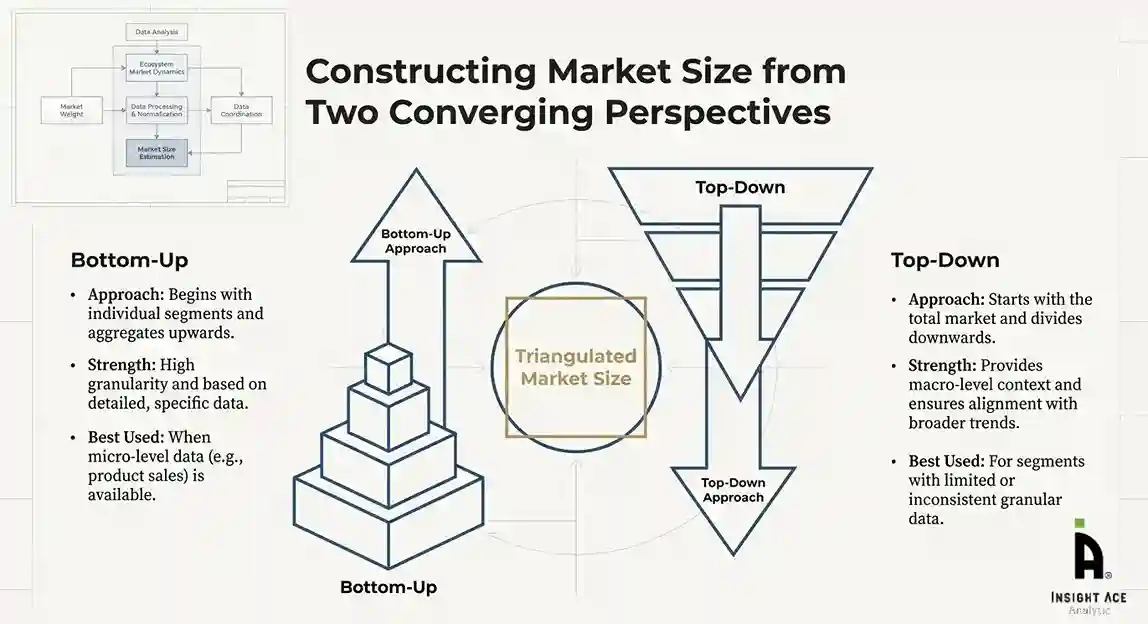
Bottom-Up Approach
The bottom-up approach involved aggregating segment-level data, such as:
- Company revenues
- Product-level sales
- Installed base/usage volumes
- Adoption and penetration rates
- Pricing analysis
This method was primarily used when detailed micro-level market data were available.
Top-Down Approach
The top-down approach used macro-level indicators:
- Parent market benchmarks
- Global/regional industry trends
- Economic indicators (GDP, demographics, spending patterns)
- Penetration and usage ratios
This approach was used for segments where granular data were limited or inconsistent.
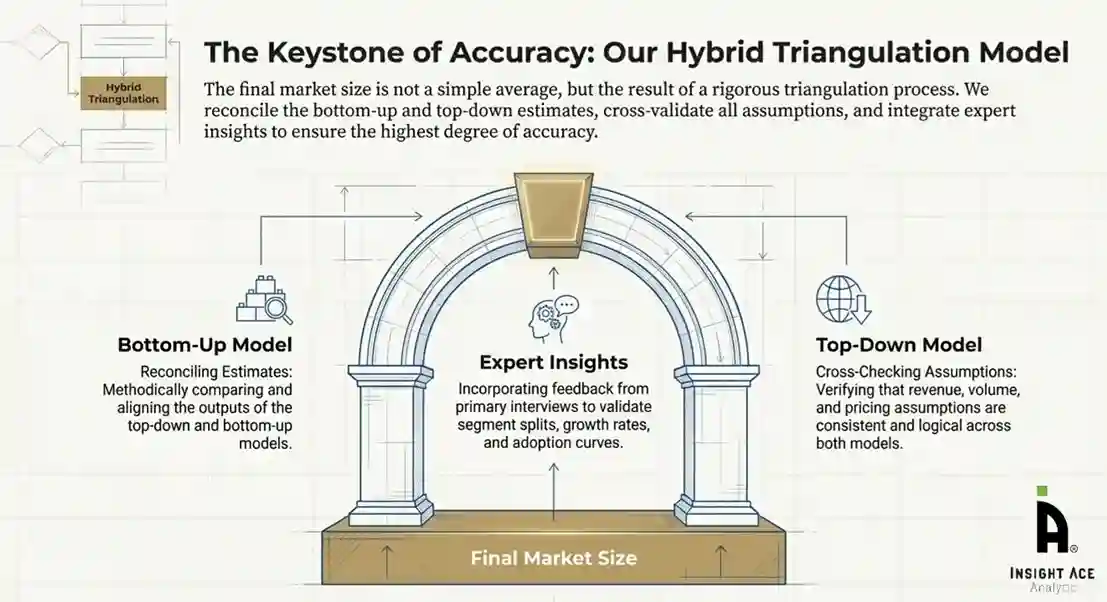
Hybrid Triangulation Approach
To ensure accuracy, a triangulated hybrid model was used. This included:
- Reconciling top-down and bottom-up estimates
- Cross-checking revenues, volumes, and pricing assumptions
- Incorporating expert insights to validate segment splits and adoption rates
This multi-angle validation yielded the final market size.
Forecasting Framework and Scenario Modelling
Market forecasts were developed using a combination of time-series modelling, adoption curve analysis, and driver-based forecasting tools.
Forecasting Methods
- Time-series modelling
- S-curve and diffusion models (for emerging technologies)
- Driver-based forecasting (GDP, disposable income, adoption rates, regulatory changes)
- Price elasticity models
- Market maturity and lifecycle-based projections
Scenario Analysis
Given inherent uncertainties, three scenarios were constructed:
- Base-Case Scenario: Expected trajectory under current conditions
- Optimistic Scenario: High adoption, favourable regulation, strong economic tailwinds
- Conservative Scenario: Slow adoption, regulatory delays, economic constraints
Sensitivity testing was conducted on key variables, including pricing, demand elasticity, and regional adoption.
Request Customization
Add countries, segments, company profiles, or extend forecast — free 10% customization with purchase.
Customize This Report →Enquire Before Buying
Speak with our analyst team about scope, methodology, pricing, or deliverable formats.
Enquire Now →Frequently Asked Questions
Robotic Nurses Market Size is valued at USD 918.36 Mn in 2024 and is predicted to reach USD 4557.09 Mn by the year 2034
Robotic Nurses Market is expected to grow at an 17.5% CAGR during the forecast period for 2025-2034.
Hstar Technologies, Diligent Robotics, Toyota Motor Corporation, RIKEN-SRK, SoftBank Robotics, Panasonic, Fraunhofer IPA, Aethon, and other prominent
Robotic Nurses market is segmented into product type, Application and end-user.
North American region is leading the Robotic Nurses market.